
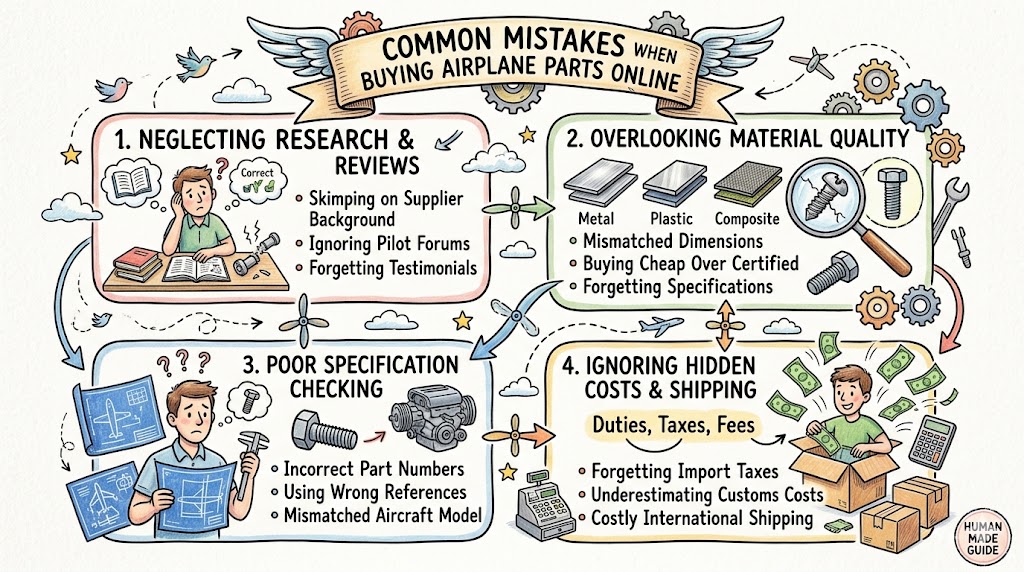
Introduction
Buying airplane parts online can be convenient, fast, and useful for aircraft owners, maintenance teams, repair shops, flight schools, and aviation buyers. Online platforms can make it easier to compare part options, check availability, request quotes, and source components that may not be available locally. However, buying aircraft parts online also comes with serious responsibility.
Airplane parts are not ordinary replacement items. They can affect aircraft safety, reliability, performance, maintenance planning, and long-term operating confidence. A wrong part, poorly documented component, damaged shipment, or unreliable supplier can lead to installation delays, costly returns, aircraft downtime, and possible safety concerns.
Many buyers make mistakes because they focus only on price or availability. While cost and delivery time are important, they should never replace compatibility checks, documentation review, supplier verification, condition assessment, and safe packaging requirements. Every aircraft part purchase should be treated as a careful technical decision.
This guide explains the most common mistakes when buying airplane parts online and how buyers can avoid them with a practical, safety-focused approach.
Why Careful Online Parts Buying Matters
Buying airplane parts online requires careful review because every part must match the aircraft, system, and intended use. Even small differences in part number, material, size, condition, certification status, or installation requirements can create major problems.
Careful online parts buying matters because it supports:
- Aircraft safety: Parts must be suitable, reliable, and properly installed.
- Correct compatibility: The part must match the aircraft model, system, and installation needs.
- Maintenance reliability: Quality parts reduce repeat issues and downtime.
- Documentation confidence: Records help verify condition, traceability, and future maintenance.
- Counterfeit risk reduction: Verified suppliers and documentation help reduce risk.
- Lower downtime: Correct parts help maintenance teams complete work faster.
- Cost control: Avoiding wrong parts reduces returns, rework, and delays.
- Long-term aircraft value: Good records and quality parts support resale and inspection confidence.
Aviation parts buying should always be based on verification, not assumptions.
Mistake 1- Buying Only Based on the Lowest Price
One of the most common mistakes is choosing airplane parts online only because they are the cheapest option. A low price may look attractive, especially when managing maintenance budgets, but the cheapest part can become expensive if it is incorrect, poorly documented, damaged, or unsuitable.
A low-cost aircraft part may have hidden problems such as:
- Missing documentation
- Unknown condition
- Incorrect part number
- Poor material quality
- Hidden wear or corrosion
- No return support
- Unclear supplier history
- High shipping fees
- Poor packaging
- Compatibility problems
- Limited technical support
A cheaper part may also create extra labor costs if it does not fit properly or requires additional verification. If the aircraft remains grounded because the wrong part was ordered, the real cost becomes much higher than the part price.
Instead of buying only based on price, compare total value. A better purchase includes the correct part number, clear condition, reliable documentation, supplier support, safe packaging, and reasonable return terms.
In aviation, value should always include safety, traceability, and reliability.
Mistake 2- Not Verifying Part Compatibility
Compatibility is one of the most important checks when buying aircraft parts online. A part that looks similar may not be correct for your aircraft. Even small differences in part number, serial range, aircraft model, connector type, material, or mounting design can make a part unsuitable.
Before ordering, buyers should confirm:
- Aircraft make and model
- Aircraft serial range
- Exact part number
- Alternate part numbers if applicable
- System compatibility
- Material specification
- Dimensions
- Mounting points
- Electrical rating if applicable
- Fuel or oil compatibility if applicable
- Installation requirements
- Maintenance manual reference where applicable
Compatibility mistakes often happen when buyers rely only on photos or general descriptions. A listing may say “fits many aircraft,” but that is not enough for aviation maintenance decisions. The buyer should verify the part against aircraft records, maintenance manuals, parts catalogs, or qualified maintenance guidance.
If compatibility is unclear, ask the seller before ordering. Never assume that a visually similar aircraft part is the correct part.
Mistake 3- Ignoring Documentation and Traceability
Documentation is critical when buying airplane parts online. It helps confirm what the part is, where it came from, what condition it is in, and whether it can be used for the intended purpose.
Useful documentation may include:
- Invoice or purchase record
- Exact part number
- Serial number where applicable
- Condition tag where applicable
- Maintenance record where applicable
- Certificate or release document where applicable
- Test report where applicable
- Installation guidance
- Supplier record
- Traceability information
- Warranty or return document
If documentation is unclear or unavailable, the buyer should treat the part with caution. For some parts, missing documentation may create inspection, installation, or resale concerns. For safety-critical parts, documentation becomes even more important.
If the seller cannot clearly state what documentation is included, write Not publicly stated and ask follow-up questions before purchasing.
Documentation is not just paperwork. It is part of the trust chain in aviation parts buying.
Mistake 4- Buying from Unverified Online Sellers
Buying from an unknown or unverified online seller can create major risk. Some sellers may not understand aviation parts standards, may describe parts incorrectly, or may not provide reliable support after the sale.
Risks of buying from unverified sellers include:
- Misrepresented parts
- Counterfeit or questionable components
- Incorrect descriptions
- Missing documentation
- Poor packaging
- No return support
- No technical assistance
- Unclear sourcing
- Delayed shipping
- Inaccurate stock status
- Poor communication
- Hidden fees
A reliable aviation parts supplier should provide clear product details, accurate part numbers, honest condition descriptions, documentation status, shipping information, and responsive communication.
Before buying, check whether the seller can answer technical questions. If the seller avoids basic details or pressures you to purchase quickly, be cautious.
A trustworthy supplier helps buyers verify the part, not just complete the sale.
Mistake 5- Not Checking Part Condition Properly
Airplane parts listed online may be described in different condition categories. Buyers should understand what these terms mean before purchasing.
Common condition descriptions may include:
- New: Unused part, but documentation should still be reviewed.
- Used: Previously installed or handled part.
- Repaired: Part that has been repaired and may need documentation.
- Overhauled: Part restored according to applicable maintenance procedures where documented.
- Serviceable: Part considered usable based on inspection or documentation.
- Surplus: Extra inventory, possibly unused but condition must still be confirmed.
- As-is: Sold without strong guarantees, often higher risk.
A listing title alone is not enough. Buyers should inspect photos carefully and ask condition questions.
Ask the seller:
- Is this part new, used, repaired, overhauled, surplus, or as-is?
- Is the part tested or inspected?
- Are there visible defects?
- Is there corrosion, wear, cracking, or damage?
- Is the actual part shown in the photos?
- What documentation confirms the condition?
- Can additional photos be provided?
Condition clarity helps buyers avoid unsafe or unusable parts.
Mistake 6- Overlooking Material Quality and Specifications
Material quality and specifications matter in aviation because parts operate under vibration, pressure, temperature changes, load, fuel exposure, electrical demand, and environmental stress. A part that looks correct may still be unsuitable if the material or specification is wrong.
Buyers should be especially careful with:
- Fasteners
- Hoses
- Fuel fittings
- Oil fittings
- Brackets
- Structural components
- Electrical connectors
- Avionics components
- Landing gear parts
- Brake parts
- Engine-related components
- Control system parts
- Seals and gaskets
Incorrect materials can lead to poor durability, leaks, corrosion, cracking, electrical faults, or structural weakness. For example, a fuel system fitting must be suitable for the fuel type and pressure environment. A fastener used in a load-bearing area must match the required strength and specification.
If material details are not listed, ask the supplier before buying. If the seller cannot verify material quality, the part may not be worth the risk.
Mistake 7- Ignoring Return Policy and Warranty Terms
Return policy and warranty terms are often overlooked, but they are very important when buying airplane parts online. Even careful buyers can receive a part that is incorrect, damaged, incompatible, or not as described.
Before ordering, review:
- Return window
- Restocking fees
- Return shipping responsibility
- Warranty coverage if available
- Damaged shipment claim process
- Conditions for returning incorrect parts
- Conditions for returning incompatible parts
- Documentation required for returns
- Refund or exchange process
Some aircraft parts may be non-returnable once opened, installed, modified, or electrically connected. Others may have strict inspection timelines after delivery. Buyers should understand these rules before purchase.
Unclear return terms can create expensive problems. A reliable supplier should explain return and warranty conditions clearly.
Mistake 8- Forgetting Shipping, Packaging, and Handling Risks
Airplane parts can be damaged during shipping if they are not packaged properly. This is especially important for fragile, precision, electrical, and high-value components.
Parts that need careful packaging include:
- Avionics
- Instruments
- Sensors
- Composite parts
- Hoses
- Seals
- Precision hardware
- Electrical components
- Fuel system parts
- Large metal parts
- Windows or transparencies
- Control components
Poor packaging can cause:
- Bent parts
- Cracked components
- Damaged connectors
- Moisture exposure
- Scratched surfaces
- Missing small hardware
- Electrical damage
- Contamination
- Broken fittings
- Corrosion risk
Before ordering, ask how the part will be packed. For high-value or fragile items, ask whether shipping insurance is available. After delivery, inspect the package before opening and document any visible damage.
Good packaging is part of quality aviation parts service.
Mistake 9- Not Considering Lead Time and Aircraft Downtime
Aircraft downtime can be expensive and inconvenient. A part that appears available online may not actually be ready to ship. Some listings may show outdated stock, backordered items, or unclear dispatch timelines.
Before buying, confirm:
- Is the part currently in stock?
- When will it ship?
- Is expedited shipping available?
- Is the part on backorder?
- Are there handling delays?
- Is documentation ready?
- Is the part located domestically or internationally?
- Are customs or import delays possible?
- Is the delivery timeline realistic?
Lead time matters especially for flight schools, maintenance shops, commercial operators, and owners trying to return an aircraft to service quickly.
A correct part that arrives too late can still create operational problems. Always confirm availability and shipping timelines before payment.
Mistake 10- Not Asking Technical Questions Before Ordering
Many online buying mistakes happen because buyers do not ask enough questions. In aviation, asking questions is not a sign of inexperience. It is a responsible buying practice.
Before ordering airplane parts online, ask:
- Is this part compatible with my aircraft?
- What is the exact part number?
- Does it match my aircraft model and serial range?
- What condition is the part in?
- Is it new, used, repaired, overhauled, surplus, or as-is?
- What documentation is included?
- Is the actual part shown in the photos?
- Are there any visible defects?
- Has the part been tested or inspected?
- What is the return policy?
- Is warranty coverage available?
- How will the part be packaged?
- Is shipping insured?
- Is technical support available after purchase?
- Are installation notes included?
A good supplier should answer these questions clearly. If answers are vague, incomplete, or rushed, take caution before buying.
New vs Used Airplane Parts
Both new and used airplane parts can be useful depending on the aircraft, part type, budget, availability, and maintenance need. However, buyers should understand the trade-offs.
Buying New Airplane Parts
New parts may offer clearer condition, lower uncertainty, and better confidence for safety-critical applications. They may also come with better packaging, supplier support, and warranty options depending on the seller.
New parts may be a better choice for:
- Safety-critical systems
- Fuel system components
- Brake parts
- Hoses and seals
- Fasteners in critical locations
- Electrical wiring
- Engine-related parts
- Structural hardware
- High-wear parts
- Parts with unknown used-life risks
Possible advantages include:
- Unused condition
- Better documentation potential
- Lower wear risk
- Easier inspection
- Better long-term confidence
Possible trade-offs include:
- Higher purchase price
- Limited availability for older aircraft
- Longer lead times in some cases
Buying Used Airplane Parts
Used parts may be acceptable for some applications when condition, compatibility, and documentation are clear. They may be helpful for older aircraft, budget-sensitive repairs, or non-critical components.
Used parts may be considered when:
- Condition is clearly documented
- Photos are detailed
- Supplier is reliable
- Return policy is clear
- Part history is acceptable
- Inspection is possible
- The part is not safety-critical or has been properly evaluated
Risks of used parts include:
- Unknown history
- Wear and fatigue
- Corrosion
- Previous damage
- Missing documentation
- Hidden defects
- Shorter service life
- Compatibility uncertainty
Used parts should always be inspected carefully before installation. For critical applications, consult a qualified maintenance professional.
Checklist Before Buying Airplane Parts Online
Use this checklist before placing an online order:
- Confirm aircraft model compatibility.
- Verify the exact part number.
- Check aircraft serial range requirements.
- Review part condition carefully.
- Ask whether the actual part is shown in photos.
- Check all available documentation.
- Ask about traceability.
- Confirm whether the part is new, used, repaired, overhauled, surplus, or as-is.
- Review supplier reputation.
- Ask technical questions before payment.
- Confirm return policy.
- Review warranty terms if available.
- Check shipping method.
- Ask about packaging quality.
- Confirm shipping insurance for high-value parts.
- Check lead time and stock availability.
- Consider installation requirements.
- Save all purchase records.
- Inspect the part immediately after delivery.
- Keep documentation with aircraft records.
A careful checklist helps reduce risk and supports better maintenance decisions.
How to Choose a Reliable Online Airplane Parts Supplier
Choosing the right supplier is as important as choosing the right part. A reliable online airplane parts supplier should make the buying process clear, transparent, and professional.
Look for a supplier that provides:
- Clear product descriptions
- Accurate part numbers
- Transparent condition details
- Aviation parts knowledge
- Documentation clarity
- Responsive communication
- Quality packaging
- Return and exchange support
- Honest inventory information
- Technical guidance where available
- Realistic delivery timelines
- Clear pricing information
A strong supplier does not hide uncertainty. If something is unknown, they should clearly state it rather than guessing. For example, if certification, traceability, or condition history is not available, they should say Not publicly stated.
Good suppliers help buyers make informed decisions, especially when the purchase affects safety and aircraft downtime.
Common Questions Buyers Should Ask Before Purchase
Before buying aircraft parts online, ask the supplier:
- Is this the exact part shown in the photos?
- What is the full part number?
- Does it match my aircraft model?
- Does it match my aircraft serial range?
- Is the part new, used, repaired, overhauled, surplus, or as-is?
- What documentation is included?
- Is traceability available?
- Has the part been tested or inspected?
- Are there any visible defects?
- Is there corrosion, wear, cracking, or damage?
- What is included in the package?
- Are seals, fittings, hardware, or accessories included?
- What is the return policy?
- Is there any warranty?
- How will the part be packed?
- Is shipping insured?
- When will the part ship?
- Is technical support available after purchase?
These questions can prevent costly ordering mistakes.
Product Photo Review Tips
When buying airplane parts online, photos are an important part of the evaluation. However, photos should support your decision, not replace documentation or compatibility checks.
When reviewing photos, look for:
- Part number markings
- Serial number markings where applicable
- Condition of connectors
- Signs of corrosion
- Cracks or dents
- Missing pieces
- Worn mounting holes
- Damaged threads
- Scratched surfaces
- Bent brackets
- Broken tabs
- Fluid residue
- Heat damage
- Packaging condition
- Labels or tags
Ask for additional photos if needed. If the listing uses generic photos, confirm whether the actual part will match the image.
Never rely only on one low-quality image for an aviation parts purchase.
Red Flags When Buying Airplane Parts Online
Some warning signs should make buyers slow down or avoid the purchase.
Red flags include:
- No clear part number
- No documentation information
- Seller avoids compatibility questions
- Very low price compared to similar listings
- Poor or missing photos
- No return policy
- No condition details
- Unclear seller identity
- Pressure to buy quickly
- Conflicting product information
- No shipping details
- No packaging explanation for fragile parts
- Claims that sound too broad or unrealistic
- Seller cannot explain source or condition
A red flag does not always prove a part is bad, but it does mean more verification is needed.
How Poor Online Buying Decisions Affect Maintenance
Buying the wrong airplane part online can create problems beyond the part itself. It can affect maintenance schedules, aircraft availability, labor costs, and operational planning.
Poor buying decisions can lead to:
- Aircraft downtime
- Failed installation attempts
- Return delays
- Extra mechanic labor
- Safety concerns
- Inspection issues
- Higher total cost
- Lost time
- Frustrated maintenance teams
- Incomplete aircraft records
- Reduced confidence in the aircraft
A careful buying process helps protect both safety and operational efficiency.
Best Practices for Buying Airplane Parts Online
To buy airplane parts online more confidently, follow these best practices:
- Start with the exact part requirement.
- Confirm compatibility before comparing prices.
- Use aircraft records and maintenance references.
- Ask for documentation before payment.
- Buy from aviation-focused suppliers.
- Avoid vague listings.
- Compare total value, not just price.
- Check return and warranty terms.
- Confirm shipping and packaging.
- Inspect parts on arrival.
- Keep all purchase records.
- Involve qualified maintenance professionals when needed.
- Avoid rushing safety-critical purchases.
- Be cautious with as-is parts.
- Do not install parts with unclear suitability.
The best aviation parts purchase is one that is correct, documented, safely delivered, and suitable for the aircraft.
FAQs
1- Is it safe to buy airplane parts online?
Yes, it can be safe to buy airplane parts online when buyers verify compatibility, documentation, supplier reputation, part condition, and shipping quality. The risk increases when buyers rely only on price, vague listings, or unverified sellers.
2- What should I check before buying airplane parts online?
Check the exact part number, aircraft compatibility, condition, documentation, traceability, supplier reputation, return policy, warranty terms, shipping method, packaging quality, and lead time. For critical parts, involve a qualified maintenance professional.
3- Why is part compatibility important?
Part compatibility ensures the component matches the aircraft model, serial range, system requirements, dimensions, material, and installation needs. An incompatible part can delay maintenance, create safety risks, or fail to install correctly.
4- What documents should come with airplane parts?
Documents may include an invoice, part number record, serial number where applicable, condition tag, certificate or release document where applicable, maintenance record, test report, or traceability details. If documentation is unclear, treat the part carefully.
5- Should I buy new or used airplane parts?
New parts may be better for safety-critical systems, wear items, hoses, seals, fuel parts, electrical wiring, and structural hardware. Used parts may be acceptable when condition, documentation, compatibility, and inspection results are clear.
6- How can I avoid counterfeit airplane parts?
Buy from reliable aviation-focused suppliers, verify documentation, confirm part numbers, inspect markings, ask about traceability, compare product details carefully, and avoid listings with vague descriptions or unusually low pricing.
7- Why does supplier reputation matter?
Supplier reputation matters because aviation parts require accurate descriptions, honest condition details, proper documentation, safe packaging, and responsive support. An unreliable seller can create safety, cost, and downtime problems.
8- What should I check in product photos?
Check part number markings, serial numbers where applicable, connectors, corrosion, cracks, dents, damaged threads, missing pieces, wear signs, labels, condition tags, and overall cleanliness. Ask for more photos if anything is unclear.
9- How important is shipping packaging for aircraft parts?
Packaging is very important because fragile, electrical, precision, and high-value aircraft parts can be damaged during shipping. Poor packaging can cause cracks, bent parts, connector damage, moisture exposure, or missing hardware.
10- What is the biggest mistake when buying airplane parts online?
The biggest mistake is buying too quickly based only on price without verifying compatibility, documentation, condition, supplier reliability, and return terms. Careful checking protects safety, budget, and aircraft maintenance schedules.
Conclusion
Buying airplane parts online can be convenient, but it should always be done with careful verification and a safety-first mindset. The right part must match the aircraft, come from a reliable supplier, include clear documentation where needed, and arrive in usable condition. Buyers should avoid choosing only the lowest price, ignoring compatibility, overlooking documentation, or buying from sellers who cannot answer technical questions. Shipping, packaging, return policy, lead time, and part condition also matter because they affect aircraft downtime and maintenance confidence. A smart buyer compares total value, not just cost, and keeps records for future maintenance. When you choose quality, traceability, and reliability over shortcuts, online aircraft parts buying becomes safer, smoother, and more dependable.

