
Introduction
Modern IT environments are highly distributed and complex, involving microservices, cloud infrastructure, APIs, containers, and hybrid systems. When an incident occurs, identifying the real source of the problem is often difficult because failures cascade across multiple layers of the stack. Traditional troubleshooting methods rely heavily on manual investigation, which slows down resolution and increases downtime.
This is why Root Cause Analysis Using Artificial Intelligence in IT Operations has become a critical capability for modern enterprises. By using machine learning, data correlation, and intelligent automation, AI can identify the underlying cause of incidents much faster than human-driven approaches.
What Is AI-Based Root Cause Analysis?
Root Cause Analysis (RCA) using Artificial Intelligence refers to the process of automatically identifying the primary source of a system failure by analyzing logs, metrics, traces, and events across distributed systems.
Instead of manually checking each service or dependency, AI systems:
- Analyze historical patterns
- Correlate related alerts
- Detect anomalies across infrastructure
- Identify failure propagation paths
- Pinpoint the most likely root cause
This transforms traditional troubleshooting into an automated, intelligent process.
Why Root Cause Analysis Is Difficult in Modern IT Systems
In enterprise environments, a single user-facing issue may involve multiple layers:
- Application services
- APIs and microservices
- Databases and storage systems
- Network and load balancers
- Cloud infrastructure
Because these systems are interconnected, one failure often triggers a chain reaction. Traditional monitoring tools generate thousands of alerts, making it difficult to determine the actual source.
AI helps solve this complexity by analyzing relationships between signals instead of treating them as isolated events.
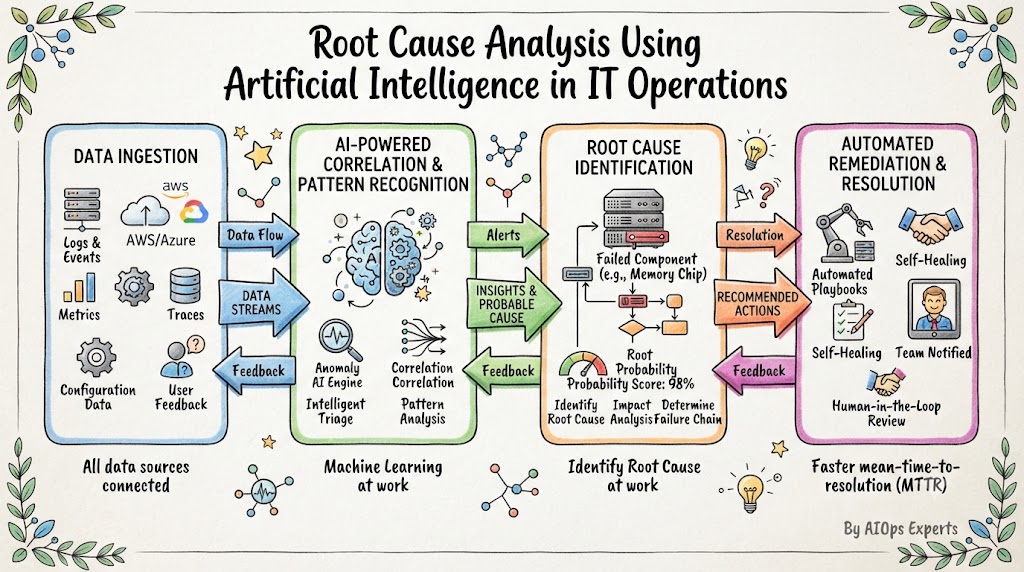
How AI Performs Root Cause Analysis
AI-driven RCA follows a structured workflow:
Data Collection
Logs, metrics, traces, and event data are continuously collected from all systems.
Signal Correlation
AI models group related events and identify patterns across services.
Anomaly Detection
Machine learning models detect abnormal behavior compared to baseline performance.
Dependency Mapping
Systems map relationships between services to understand failure propagation.
Root Cause Identification
AI identifies the most probable source of the issue based on correlation and impact analysis.
Recommendation or Automation
The system suggests remediation steps or triggers automated fixes.
Traditional RCA vs AI-Based RCA
| Aspect | Traditional RCA | AI-Based RCA |
|---|---|---|
| Approach | Manual investigation | Automated analysis |
| Speed | Slow | Real-time or near real-time |
| Accuracy | Depends on human expertise | Data-driven insights |
| Scalability | Limited | High scalability |
| Alert Handling | Isolated alerts | Correlated incidents |
AI-based RCA significantly reduces the time required to resolve incidents in complex environments.
Key Benefits of AI in Root Cause Analysis
Organizations adopting Root Cause Analysis Using Artificial Intelligence in IT Operations experience several benefits:
- Faster incident resolution
- Reduced mean time to repair (MTTR)
- Improved system reliability
- Reduced alert noise and confusion
- Better visibility into distributed systems
- Improved collaboration between teams
These improvements directly enhance operational efficiency and customer experience.
Role of AI in AIOps and IT Operations
AI-powered RCA is a core component of modern AIOps in IT operations.
It enables systems to:
- Automatically detect incidents
- Correlate related events across services
- Identify failure patterns in real time
- Support predictive incident management
- Enable self-healing infrastructure
In AIOps environments, RCA is not a standalone function but part of a continuous intelligence loop.
Real-World Example of AI Root Cause Analysis
A global SaaS platform experiences intermittent API failures affecting user login services.
Without AI, engineers receive hundreds of alerts from different systems—API gateways, authentication services, databases, and network layers.
With AI-based RCA:
- The system detects abnormal authentication latency
- It correlates database connection timeouts
- Dependency mapping shows connection pool exhaustion
- AI identifies misconfigured database scaling limits as the root cause
- Automated remediation adjusts configuration and restores service
The issue is resolved in minutes instead of hours.
Technologies Behind AI-Based RCA
Modern RCA systems rely on several technologies:
- Machine learning models for anomaly detection
- Time-series analysis for performance trends
- Graph-based dependency mapping
- Log analytics engines like ELK and Splunk
- Observability platforms such as Datadog and Dynatrace
- OpenTelemetry for unified telemetry collection
These technologies work together to provide end-to-end system intelligence.
Challenges in Implementing AI Root Cause Analysis
Despite its benefits, organizations face challenges:
Data Quality Issues
Incomplete or noisy telemetry data reduces accuracy.
Complex System Integration
Multiple tools and platforms must be unified.
Lack of Skilled Professionals
Teams need expertise in AIOps, observability, and AI systems.
False Positives
Poorly tuned models may incorrectly identify root causes.
Structured AIOps Training helps overcome these challenges by building practical skills.
AI Root Cause Analysis for SRE and DevOps Teams
For AIOps for SRE, AI-based RCA improves key reliability metrics such as MTTD and MTTR by accelerating incident resolution.
For DevOps teams, it ensures faster identification of deployment-related issues and reduces rollback risks.
Together, these teams benefit from faster feedback loops and improved system stability.
Common Mistakes in Traditional RCA
Organizations often struggle due to:
- Treating alerts as isolated events instead of correlated signals
- Relying too heavily on manual debugging
- Ignoring system dependency mapping
- Lack of centralized observability
- Delayed incident escalation
AI eliminates many of these challenges by automating correlation and analysis.
Career Opportunities in AI-Based RCA
The growing adoption of AIOps and intelligent monitoring has created demand for professionals skilled in:
- AIOps engineering
- SRE and reliability engineering
- Cloud observability
- DevOps automation
- Incident response engineering
Learning through structured AIOps Course, AIOps Training, and certification programs helps professionals build strong careers in this field.
Why AI Root Cause Analysis Is the Future
As IT systems continue to grow in complexity, manual troubleshooting will become increasingly ineffective. AI-based RCA enables organizations to shift from reactive problem-solving to proactive and predictive operations.
This leads to:
- Faster incident resolution
- Lower operational costs
- Improved service reliability
- Better user experience
- Scalable IT operations
AI-driven RCA is becoming a foundational pillar of autonomous IT operations.
Final Thoughts
Root Cause Analysis using Artificial Intelligence is transforming the way enterprises handle IT incidents. By combining automation, machine learning, and observability, organizations can quickly identify and resolve issues that would otherwise take hours or days to diagnose.
As adoption grows, professionals with expertise in AIOps Training and modern IT operations will play a key role in building reliable, intelligent systems for the future.

