
Aircraft propellers are critical components of an aircraft’s propulsion system, and the parts associated with them require careful selection. Whether you are replacing a worn component, restoring an aircraft, upgrading equipment, or maintaining a propeller system, choosing the correct part is about much more than finding something that looks similar or has an attractive price.
A propeller component must be compatible with the specific aircraft, engine, propeller, and installation configuration. Documentation, traceability, condition, and applicable airworthiness requirements can also matter.
Unfortunately, buyers can make avoidable mistakes when purchasing aircraft propeller parts. Some problems come from relying on incomplete product descriptions, while others result from overlooking part numbers, maintenance history, or regulatory requirements.
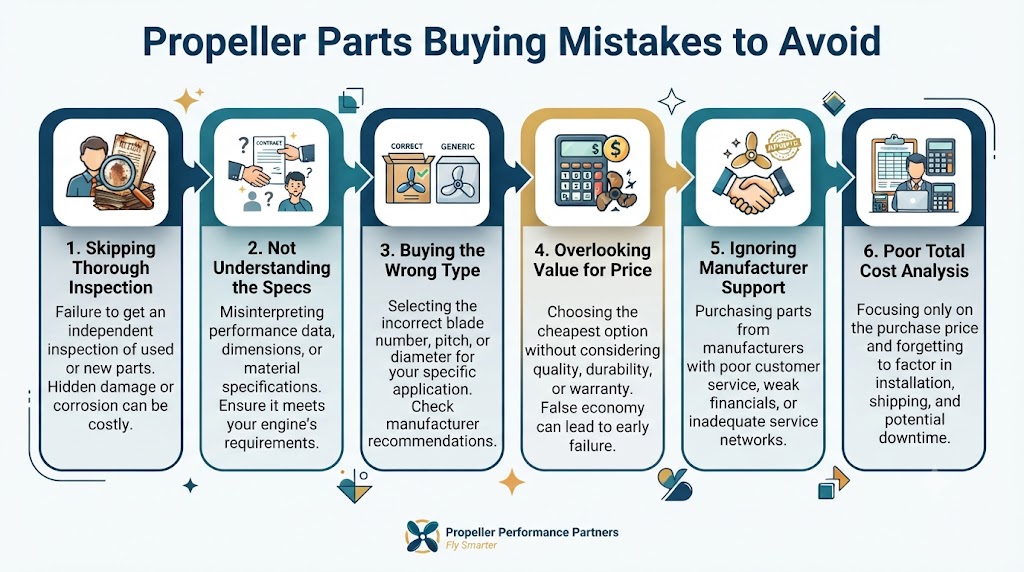
This guide explains the most important propeller parts buying mistakes to avoid and provides practical considerations for making more informed purchasing decisions.
Understanding Aircraft Propeller Parts
An aircraft propeller is a system rather than simply a set of blades.
Depending on the design, associated components may include:
- Propeller blades
- Hubs
- Spinners
- Spinner bulkheads
- Bearings
- Bushings
- Seals
- Fasteners
- Mounting hardware
- Governors or related components
- Other model-specific accessories
Not every propeller uses the same components, and parts that appear similar may not be interchangeable.
The exact requirements depend on the propeller manufacturer, propeller model, aircraft, engine, and configuration.
That is why identifying the specific application should always be the first step before purchasing a replacement part.
Why Propeller Parts Require Careful Selection
Propeller components operate in a demanding environment involving rotational forces, aerodynamic loads, vibration, and changing operating conditions.
An incorrectly selected component may create compatibility or maintenance problems and could affect the proper functioning of the propeller system.
Buyers should therefore consider:
- Exact part compatibility
- Manufacturer documentation
- Part number
- Condition
- Traceability
- Regulatory requirements
- Supplier reliability
- Installation requirements
- Long-term support
A careful purchasing process can help prevent costly mistakes and unnecessary delays.
Mistake #1: Buying Based Only on Price
One of the most common mistakes is choosing the cheapest available propeller component without considering its complete suitability.
Price matters, but it should not be the only factor.
A less expensive component may have limitations involving:
- Compatibility
- Documentation
- Condition
- Traceability
- Supplier support
- Warranty
- Availability of technical information
When purchasing an aviation component, the better question is not simply:
“Which part costs less?”
Instead, ask:
“Which appropriate part provides the right combination of compatibility, documentation, condition, and value?”
For safety-critical aircraft components, a low price should never replace proper verification.
Mistake #2: Buying the Wrong Part for the Propeller Model
A part that looks correct may still be unsuitable for a particular propeller.
Before ordering, verify information such as:
- Aircraft model
- Engine model
- Propeller manufacturer
- Propeller model
- Propeller serial number where applicable
- Exact part number
- Applicable configuration
- Relevant manufacturer documentation
This is particularly important when shopping through online marketplaces where photographs and descriptions may not provide complete technical information.
Never assume that two components are interchangeable simply because they look nearly identical.
Mistake #3: Ignoring Part Numbers and Technical Documentation
Part numbers exist for an important reason: they identify specific components and configurations.
A buyer should avoid relying exclusively on:
- Product photographs
- Generic descriptions
- Seller terminology
- Search-engine results
- Forum recommendations
- Informal compatibility claims
Instead, verify the component using authoritative documentation such as applicable:
- Parts catalogs
- Illustrated parts catalogs
- Manufacturer manuals
- Service information
- Technical publications
- Component documentation
A correct part number can be one of the most useful pieces of information when purchasing an aircraft component.
Why Documentation Matters
Technical documentation may identify:
- Original part numbers
- Replacement part numbers
- Superseded components
- Applicable configurations
- Installation limitations
- Inspection requirements
A part that has been replaced or superseded by another component should be evaluated according to the manufacturer’s current information.
Mistake #4: Assuming Universal Compatibility
There is no universal aircraft propeller component that fits every aircraft.
Compatibility can depend on:
- Propeller design
- Hub configuration
- Engine
- Aircraft
- Mounting arrangement
- Component geometry
- Manufacturer requirements
Even seemingly simple components can have application-specific requirements.
For this reason, buyers should verify compatibility before placing an order rather than assuming that a component described as an “aircraft propeller part” will fit their aircraft.
Mistake #5: Ignoring Certification and Airworthiness Requirements
Aircraft parts may be subject to specific certification, approval, documentation, or airworthiness requirements depending on the aircraft category, jurisdiction, and intended operation.
Before purchasing, determine whether the component is appropriate for the intended aircraft and operation.
Consider:
- Applicable aviation authority requirements
- Approval status where applicable
- Manufacturer documentation
- Traceability
- Airworthiness considerations
- Installation eligibility
Requirements can differ between jurisdictions and aircraft categories.
Always verify current requirements with the appropriate aviation authority and qualified aviation professionals rather than relying on outdated online information.
Mistake #6: Buying Used Parts Without Checking Their History
Used aircraft propeller components can sometimes be an option, but buyers should understand the risks involved.
A used part may have:
- Unknown service history
- Previous repairs
- Corrosion
- Wear
- Damage
- Improper storage history
- Missing documentation
- Unknown modifications
A low price does not automatically make a used part a good value.
What Should You Investigate?
When considering a used component, ask whether relevant documentation is available and whether the part can be appropriately evaluated for the intended application.
For safety-critical components, professional inspection may be necessary to determine whether a used part is suitable for continued service.
Mistake #7: Overlooking Material and Construction
Aircraft propeller components can be manufactured using different materials and construction methods.
Depending on the design, components may involve:
- Aluminum
- Composite materials
- Steel
- Other specialized aircraft materials
Material selection is not simply a matter of personal preference.
The component must be appropriate for the specific propeller and application.
Replacing a component with one made from a different material without confirming compatibility can create problems involving strength, weight, fit, corrosion behavior, or other characteristics.
Always follow the applicable manufacturer’s specifications.
Mistake #8: Failing to Check Dimensions and Configuration
Physical compatibility is another important consideration.
Depending on the component, buyers may need to verify details such as:
- Mounting configuration
- Bolt-hole pattern
- Hub configuration
- Spinner dimensions
- Interface geometry
- Component shape
- Other application-specific dimensions
However, physical dimensions alone do not establish compatibility.
Two components can have similar dimensions while differing in material, specification, certification status, or intended application.
This is why the correct part number and manufacturer documentation remain important.
Mistake #9: Ignoring the Condition of the Part
A component can have the correct part number and still require careful condition assessment.
This is especially important when purchasing used parts.
Potential concerns may include:
- Cracks
- Corrosion
- Deformation
- Excessive wear
- Surface damage
- Improper repairs
- Missing hardware
Visual inspection can identify obvious problems, but it may not establish the complete serviceability of an aviation component.
When the condition of a safety-critical component is uncertain, seek evaluation by an appropriately qualified aviation professional.
Mistake #10: Buying Without Considering the Complete Propeller System
A propeller should be considered as part of the aircraft’s overall propulsion system.
Relevant components may include:
Engine → Propeller → Hub → Mounting components → Spinner → Related systems
Depending on the aircraft and propeller design, other systems may also be involved.
Changing one component can sometimes affect the compatibility or requirements of related components.
For example, selecting a component without considering the specific hub or propeller configuration could result in a part that cannot be properly integrated into the existing system.
Always evaluate the complete application.
Mistake #11: Ignoring Manufacturer Service Information
Manufacturers may issue technical updates during the service life of a component.
These can include:
- Service bulletins
- Service letters
- Technical notices
- Inspection recommendations
- Updated components
- Replacement recommendations
A buyer should check applicable manufacturer information before purchasing or installing a component.
This is particularly important for older aircraft and propeller systems.
A part that was appropriate at one point may have been superseded or subject to updated requirements.
Mistake #12: Choosing an Unverified Supplier
The supplier matters almost as much as the part itself.
A reputable aviation-parts supplier should be able to provide appropriate information about the component and its application.
When evaluating a supplier, consider:
- Aviation industry experience
- Product documentation
- Part traceability
- Authenticity
- Customer support
- Warranty information
- Return policy
- Technical knowledge
Be cautious when a supplier cannot provide basic information needed to verify the part.
For critical aircraft components, transparency is important.
Mistake #13: Failing to Confirm Delivery and Return Policies
Specialized aircraft components can sometimes be difficult or expensive to return.
Before ordering, understand:
- Shipping time
- Shipping costs
- Return conditions
- Restocking fees
- Warranty terms
- Exchange procedures
- International shipping requirements
A buyer who does not verify these details may discover additional costs after placing an order.
This is especially important when ordering a component that requires exact aircraft or propeller compatibility.
Mistake #14: Not Planning for Installation and Inspection Costs
The price of the component is not necessarily the total cost of the project.
Additional expenses may include:
- Professional installation
- Inspection
- Balancing where applicable
- Related maintenance
- Documentation
- Shipping
- Replacement of associated hardware
When budgeting for a propeller component, consider the entire project.
A component that costs less but requires additional work may ultimately cost more than a properly specified alternative.
Mistake #15: Relying on Generic Online Information
The internet is useful for researching aircraft parts, but not every online source provides reliable technical information.
Forums, social-media posts, marketplace listings, and general aviation discussions can contain useful experiences, but they should not replace authoritative documentation.
Use online information to identify possible options, then verify the final decision against appropriate technical sources.
For safety-critical components, the final compatibility decision should be based on reliable documentation and qualified professional guidance.
How to Buy Aircraft Propeller Parts More Carefully
A structured purchasing process can significantly reduce the risk of selecting the wrong component.
Step 1: Identify the Aircraft
Record the aircraft manufacturer, model, and relevant configuration.
Step 2: Identify the Engine
Confirm the engine manufacturer and model.
Step 3: Identify the Propeller
Determine the propeller manufacturer, model, and serial number where applicable.
Step 4: Find the Exact Part Number
Use the applicable parts catalog or manufacturer documentation.
Step 5: Check Current Documentation
Look for current manufacturer information, service updates, and applicable technical requirements.
Step 6: Verify Compatibility
Confirm that the component is intended for the exact application.
Step 7: Review Regulatory Requirements
Determine whether there are specific approval, certification, traceability, or airworthiness requirements.
Step 8: Evaluate the Supplier
Check the supplier’s aviation experience, documentation, support, and return policies.
Step 9: Evaluate New vs. Used
If considering a used component, investigate its history, documentation, and condition.
Step 10: Calculate the Complete Cost
Include the part, shipping, inspection, installation, and any related expenses.
Step 11: Consult a Qualified Professional
When there is uncertainty about compatibility or serviceability, obtain appropriate professional advice before purchasing or installing the component.
New vs. Used Propeller Parts
Both new and used components may be available in the aircraft-parts market, but each option requires careful evaluation.
New Parts
Potential advantages include:
- Known source
- Current manufacturing status
- Manufacturer documentation
- Warranty where offered
- Predictable condition
However, new does not automatically mean compatible. The exact part still needs to be verified.
Used Parts
Potential advantages may include:
- Lower purchase cost
- Availability of older components
- Access to discontinued parts in certain circumstances
However, buyers need to pay particular attention to:
- Service history
- Condition
- Traceability
- Previous repairs
- Documentation
- Regulatory eligibility
The right choice depends on the aircraft, component, applicable requirements, and professional assessment.
Propeller Parts Buying Checklist
Before purchasing an aircraft propeller component, review the following:
- Aircraft model confirmed
- Engine model confirmed
- Propeller manufacturer confirmed
- Propeller model confirmed
- Serial number verified where applicable
- Exact part number confirmed
- Manufacturer documentation reviewed
- Compatibility verified
- Applicable regulatory requirements checked
- Part condition evaluated
- Used-part history reviewed if applicable
- Supplier reputation checked
- Traceability information reviewed
- Warranty and return policy reviewed
- Shipping requirements confirmed
- Installation and inspection costs considered
Frequently Asked Questions
How do I know which propeller part fits my aircraft?
Start by identifying the aircraft, engine, and propeller model. Then use the applicable manufacturer’s parts documentation to identify the correct part number and verify compatibility.
Are aircraft propeller parts interchangeable?
Not necessarily. Compatibility depends on the specific propeller, engine, aircraft, configuration, and manufacturer requirements.
Should I buy new or used propeller parts?
Either may be appropriate depending on the component and application. Used parts require particularly careful evaluation of condition, history, documentation, and regulatory eligibility.
Why are propeller part numbers important?
Part numbers help identify the exact component and configuration. They reduce the risk of purchasing a visually similar but technically incompatible part.
How can I verify an aircraft propeller part?
Compare the part number and application against current manufacturer documentation and, where appropriate, consult a qualified aviation professional.
What should I check when buying used propeller parts?
Investigate the part’s history, condition, documentation, previous repairs, corrosion, wear, and traceability. Professional evaluation may be appropriate for safety-critical components.
Why is manufacturer documentation important?
Manufacturer documentation provides authoritative information about component identification, compatibility, service requirements, revisions, and other technical considerations.
How do certification and airworthiness requirements affect propeller parts?
Depending on the aircraft and jurisdiction, specific requirements may apply to the eligibility, approval, documentation, installation, and continued use of aircraft components.
Should I consult a mechanic before buying a propeller component?
If you are uncertain about compatibility, condition, or installation requirements, consulting an appropriately qualified aviation professional before purchasing can help prevent costly mistakes.
What should I consider when choosing a propeller-parts supplier?
Consider aviation experience, product authenticity, documentation, traceability, customer support, warranty, return policies, and the supplier’s ability to provide reliable application information.
Final Thoughts
Buying aircraft propeller parts requires more research than simply finding a component that appears to fit.
The most common mistakes include choosing parts based solely on price, ignoring part numbers, assuming universal compatibility, overlooking documentation, purchasing used components without investigating their history, and failing to consider regulatory requirements.
A careful buyer starts with identification. Confirm the aircraft, engine, propeller, configuration, and exact part number before comparing suppliers or prices.
From there, review current technical documentation, verify compatibility, evaluate the component’s condition and traceability, understand the supplier’s policies, and consider the complete cost of obtaining and appropriately installing or inspecting the part.
Most importantly, remember that propeller components are safety-critical aircraft equipment. When there is uncertainty, the safest approach is to stop and obtain guidance from the appropriate manufacturer documentation and a qualified aviation professional rather than making an assumption.

