
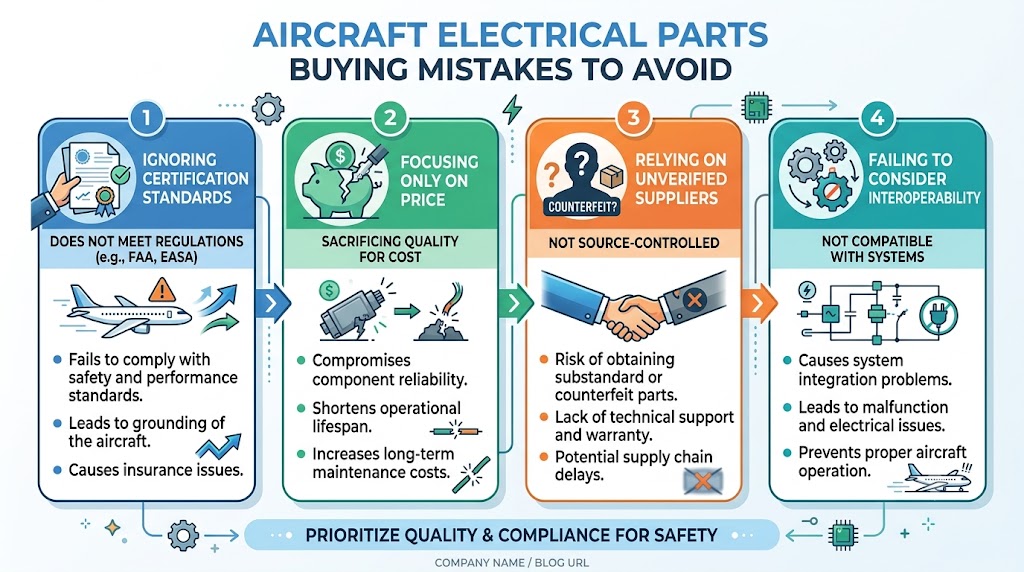
Aircraft electrical systems support essential functions ranging from engine starting and power distribution to lighting, communication, navigation, instrumentation, and protective systems. Because these systems are interconnected, a seemingly minor purchasing mistake can create compatibility, reliability, maintenance, or airworthiness problems.
Buying an aircraft electrical part is therefore not simply a matter of finding a component with the correct name or connector. The buyer needs to establish part identity, eligibility, specifications, traceability, condition, documentation, and application compatibility before the component is accepted for installation.
For U.S. type-certificated aircraft, the FAA specifically provides guidance concerning the eligibility, quality, and identification of aeronautical replacement parts. Electrical-system maintenance guidance also emphasizes proper condition, installation, connections, wiring, bonding, grounding, protection, and operational checks.
This guide explains the most common aircraft electrical parts buying mistakes and how to avoid them.
Why Aircraft Electrical Parts Require Careful Purchasing
Aircraft electrical components operate in an environment where vibration, temperature variation, moisture, electrical loads, electromagnetic effects, and limited maintenance access can all affect reliability.
A component that appears suitable on a workbench may not be appropriate for a particular aircraft installation.
Common electrical parts include:
- Circuit breakers
- Switches
- Relays
- Contactors
- Connectors
- Terminal blocks
- Fuses
- Wiring and cable
- Batteries and related components
- Alternator and generator components
- Voltage regulators
- Electrical indicators
- Lighting components
- Motors
- Solenoids
- Sensors
- Avionics-related electrical components
- Bonding and grounding hardware
The key purchasing question is not simply:
“Does this part look like the old one?”
The better question is:
“Can this specific part be demonstrated to be suitable and eligible for this specific application?”
That distinction prevents many expensive mistakes.
1. Buying by Appearance Instead of Exact Part Identification
One of the most common mistakes is purchasing a component because it looks identical to the existing part.
Two relays, switches, circuit breakers, or connectors may have similar dimensions while having substantially different electrical characteristics.
Before purchasing, verify information such as:
- Manufacturer
- Exact part number
- Model or series
- Revision or configuration where applicable
- Electrical rating
- Voltage rating
- Current rating
- Terminal configuration
- Contact arrangement
- Environmental characteristics
- Applicable aircraft or component documentation
A visual match is useful as an initial clue, but it should never be the final verification.
Better approach
Start with the aircraft maintenance documentation, illustrated parts information, component documentation, or other applicable approved or accepted data. Then cross-check the exact part identification with the supplier’s documentation.
2. Assuming a Similar Part Is Automatically an Equivalent
“Equivalent” is one of the most misunderstood words in aircraft parts purchasing.
A replacement component may need to match more than basic electrical function.
Relevant characteristics can include:
- Electrical performance
- Mechanical dimensions
- Mounting arrangement
- Connector configuration
- Contact ratings
- Operating temperature
- Vibration resistance
- Environmental performance
- Insulation characteristics
- Weight
- Reliability requirements
- Compatibility with surrounding equipment
FAA electrical-system guidance states that replacement components should be identical, manufacturer-approved, or equivalent in relevant operating characteristics, mechanical strength, and environmental specifications where the guidance applies.
Therefore, replacing a component based solely on voltage and current ratings can be inadequate.
3. Ignoring Aircraft-Specific Documentation
Another purchasing mistake is treating a generic catalog specification as sufficient evidence of suitability.
Aircraft components are installed within specific systems and configurations.
Before ordering, check the applicable:
- Aircraft maintenance manual
- Illustrated parts information
- Component maintenance information
- Wiring diagrams
- Service information
- Manufacturer instructions
- Approved modification documentation
- Applicable regulatory information
The applicable documentation depends on the aircraft, component, maintenance activity, and regulatory environment.
Why this matters
A component can be electrically functional but still be inappropriate for the aircraft configuration.
The safest purchasing process starts with aircraft documentation and part identification, not a generic internet search.
4. Choosing the Cheapest Part Without Evaluating Traceability
Price matters, but the lowest purchase price does not necessarily represent the lowest total cost.
A low-cost component can become expensive if it creates:
- Verification work
- Installation delays
- Documentation problems
- Rejection during inspection
- Premature failure
- Troubleshooting time
- Repeat removal and installation
- Additional shipping costs
- Aircraft downtime
For aircraft parts, traceability is especially important. FAA guidance addresses the quality, eligibility, and traceability of aeronautical replacement parts intended for installation on type-certificated products.
A supplier that can clearly document the identity and provenance of a component may provide more useful value than a cheaper supplier with incomplete documentation.
5. Failing to Check Part Eligibility
A part being commercially available does not automatically mean that it is eligible for installation on a particular aircraft.
This is one of the most important distinctions in aircraft parts purchasing.
Before purchasing, determine:
- What aircraft or component is receiving the part?
- What part number is required?
- What approval or eligibility basis applies?
- What documentation accompanies the part?
- Can the supplier establish the part’s identity and traceability?
- Does the installation require additional approval or documentation?
The FAA maintains guidance concerning aeronautical replacement-part eligibility and also operates a Suspected Unapproved Parts program.
For applicable parts, do not treat a seller’s statement that a component is “aircraft grade” as a substitute for proper verification.
6. Assuming an FAA Form or Certification Document Solves Everything
Documentation is valuable, but buyers should understand what the documentation actually establishes.
A document should be reviewed for:
- Correct part number
- Quantity
- Serial or batch information where applicable
- Condition
- Applicable approvals
- Authorized signatures or certification
- Consistency with the physical part
- Traceability information
The document should correspond to the actual item being purchased.
A document that cannot be connected clearly to the physical component is not as useful as complete, consistent documentation.
Maintenance recordkeeping and FAA Form 8130-3 practices are addressed separately in FAA guidance, emphasizing the importance of proper maintenance records and return-to-service documentation.
7. Not Checking the Condition of Used or Overhauled Parts
Used aircraft electrical components can sometimes be legitimate purchasing options, but condition must be established carefully.
Potential concerns include:
- Unknown service history
- Corrosion
- Contamination
- Damaged terminals
- Worn contacts
- Previous overheating
- Incorrect repairs
- Storage damage
- Missing documentation
- Shelf-life concerns where applicable
- Unclear modification history
A used part should not be treated as equivalent to a new part simply because it has the same part number.
Ask the supplier what condition the component is in and what supporting documentation is available.
8. Ignoring Storage and Shelf-Life Requirements
Some electrical and related aircraft components can be affected by storage conditions or shelf-life limitations.
Depending on the component, relevant considerations may include:
- Temperature
- Humidity
- Packaging
- Contamination
- Corrosion protection
- Battery condition
- Seal integrity
- Manufacturer-defined shelf life
- Storage duration
- Preservation requirements
A part that has spent years in uncontrolled storage may require substantially more scrutiny than a recently manufactured and properly preserved component.
Purchasing lesson
Do not ask only:
“Is it new?”
Also ask:
“How was it stored, and can its storage condition be established?”
9. Buying the Correct Electrical Rating but the Wrong Physical Configuration
Electrical ratings are only one part of compatibility.
A component can have an apparently suitable voltage and current rating while having:
- Different terminal positions
- Different mounting holes
- Different connector keying
- Different contact arrangement
- Different actuator geometry
- Different dimensions
- Different clearance requirements
This can create installation problems or lead to improper modifications.
Before ordering, compare the complete configuration rather than one specification.
10. Ignoring Environmental Requirements
Aircraft electrical equipment may be exposed to conditions that ordinary commercial equipment never experiences.
Consider:
- Temperature extremes
- Vibration
- Moisture
- Altitude
- Electrical transients
- Contamination
- Corrosive environments
- Mechanical stress
An ordinary commercial electrical component can therefore be a poor substitute for a component designed and qualified for the intended aircraft environment.
This is particularly important for components located in:
- Engine compartments
- Wheel-well areas
- Battery compartments
- Exterior locations
- High-temperature zones
- Areas subject to significant vibration
11. Buying Connectors Without Verifying the Complete Connector System
Connectors are often purchased incorrectly because buyers focus only on the visible connector housing.
A complete connector system can involve:
- Housing
- Contacts
- Pins or sockets
- Backshell
- Sealing components
- Strain relief
- Locking mechanisms
- Keying
- Wire size compatibility
- Plating or material requirements
A connector housing alone may not be enough.
Before purchasing, confirm the complete connector configuration and the components required to build the intended assembly.
12. Treating Wiring as Generic Commodity Material
Aircraft wire should not automatically be treated like ordinary electrical wire.
Important characteristics can include:
- Conductor size
- Insulation type
- Temperature rating
- Voltage rating
- Environmental resistance
- Flexibility
- Shielding
- Weight
- Compatibility with terminals and connectors
Electrical-system guidance emphasizes the importance of proper wiring condition, support, connections, insulation, bonding, grounding, and operational checks.
A purchasing decision should therefore consider the complete application rather than selecting wire solely because the conductor size appears correct.
13. Forgetting Terminal and Contact Compatibility
A wire can have the correct size while the selected terminal or contact is unsuitable.
Potential mismatches include:
- Incorrect wire size range
- Incorrect contact type
- Incorrect crimp requirements
- Incorrect plating
- Incorrect connector family
- Incompatible tooling
- Incorrect insulation support
The terminal, contact, connector, and wire should be treated as a system.
This is particularly important when purchasing components separately from different suppliers.
14. Buying Circuit Protection Based Only on Amperage
Circuit protection requires more than matching a number printed on the old component.
Depending on the application, the selection can involve:
- Current rating
- Voltage rating
- Circuit characteristics
- Environmental conditions
- Trip characteristics
- Physical configuration
- Manufacturer requirements
- Applicable aircraft documentation
Replacing a protective device with a higher-rated component merely because the original one trips frequently can introduce a serious design and maintenance problem.
Frequent circuit protection operation should be investigated rather than defeated through a larger rating.
15. Ignoring Polarity, Contact Arrangement, or Switching Function
Switches and relays may look nearly identical while performing different functions.
Before buying, verify:
- Normally open versus normally closed configuration
- Pole count
- Throw configuration
- Coil voltage
- Contact rating
- Terminal arrangement
- Actuation characteristics
- Switching requirements
This mistake is especially common when purchasing visually similar replacement components from general industrial catalogs.
16. Failing to Investigate Why the Original Part Failed
Replacing the failed component without understanding the failure can result in repeated failures.
For example, an electrical component may fail because of:
- Excessive current
- Overheating
- Poor connection
- Vibration
- Corrosion
- Voltage problems
- Mechanical interference
- Wiring damage
- Incorrect installation
- An underlying system fault
Buying another identical component without investigating the cause can simply restart the same failure cycle.
Better purchasing process
Treat a failed component as information.
Ask:
Why did it fail?
Then verify whether the replacement addresses the original requirement without masking the underlying problem.
17. Buying From a Supplier With Weak Traceability
Supplier selection matters almost as much as part selection.
Warning signs can include:
- Incomplete part identification
- Unclear condition
- Missing documentation
- Unexplained substitutions
- Inconsistent labeling
- Unusually vague descriptions
- Unclear origin
- Pressure to purchase before documentation is provided
The FAA’s Suspected Unapproved Parts program exists specifically to identify and address suspected unapproved parts and provides mechanisms for reporting concerns.
A professional supplier should be able to provide enough information for the buyer and maintenance organization to evaluate the component appropriately.
18. Assuming “New Old Stock” Means Risk-Free
New old stock can be unused while still having been stored for a long period.
That can raise questions about:
- Storage conditions
- Packaging
- Corrosion
- Shelf life
- Manufacturer status
- Documentation
- Obsolescence
- Configuration
“Unused” describes usage history. It does not automatically establish current suitability.
19. Ignoring Obsolescence
Aircraft can remain operational for many years, while individual electrical components may become obsolete.
An obsolete component may create challenges involving:
- Replacement availability
- Approved alternatives
- Documentation
- Connector compatibility
- Maintenance support
- Future sourcing
- Configuration control
Before buying the last available unit of an old component, determine whether there is a documented replacement strategy.
This is particularly important for aircraft operators who need predictable maintenance support over time.
20. Selecting a Modern Replacement Without Reviewing the Installation
A newer component may have improved specifications but still require careful evaluation.
Potential differences can include:
- Power consumption
- Heat generation
- Connector configuration
- Electrical characteristics
- Weight
- Physical dimensions
- Mounting requirements
- System compatibility
- Documentation requirements
“Newer” should therefore not be treated as synonymous with “drop-in replacement.”
21. Forgetting About Configuration Control
Aircraft maintenance becomes more difficult when the parts installed do not match the documentation.
A disciplined purchasing process should preserve:
- Part numbers
- Serial numbers where applicable
- Supplier information
- Documentation
- Purchase records
- Applicable approvals
- Installation references
- Configuration information
Good records make future troubleshooting and maintenance substantially easier.
22. Not Involving the Qualified Maintenance Professional Early Enough
Purchasing decisions should not be separated from installation and maintenance requirements.
Before ordering a questionable substitute, involve the appropriate qualified maintenance professional or organization.
They can help determine:
- Whether the part is appropriate
- Whether the part is eligible
- Whether documentation is sufficient
- Whether an alternative is acceptable
- Whether additional maintenance or approval requirements apply
- Whether the component matches the aircraft configuration
This can prevent the common situation where an inexpensive part arrives only to be rejected during installation.
23. Treating Supplier Catalogs as the Final Authority
Supplier catalogs are useful for finding parts, but the catalog should not replace aircraft-specific technical documentation.
Use supplier information to identify potential components.
Then verify the selection against the applicable aircraft and component documentation.
A strong process is:
Aircraft documentation → exact part identification → supplier verification → eligibility/traceability review → purchase → receiving inspection
Not:
Search engine → cheapest listing → order
A Practical Aircraft Electrical Parts Buying Workflow
A disciplined purchasing workflow can be organized into seven stages.
| Stage | What to Verify |
|---|---|
| 1. Identify | Exact part number, manufacturer, configuration |
| 2. Define application | Aircraft, system, component location |
| 3. Verify specifications | Electrical, mechanical, environmental requirements |
| 4. Verify eligibility | Applicable approval or eligibility basis |
| 5. Verify traceability | Supplier, origin, documentation, identification |
| 6. Inspect on receipt | Physical condition and documentation consistency |
| 7. Release for maintenance | Qualified personnel verify suitability before installation |
This process may take longer than simply ordering a replacement, but it reduces the chance of purchasing a component that cannot be properly used.
Aircraft Electrical Parts Purchasing Checklist
Before approving an electrical component for purchase, verify the following.
Part Identification
- Exact part number confirmed
- Manufacturer confirmed
- Configuration confirmed
- Revision or variant checked where applicable
Technical Compatibility
- Voltage verified
- Current rating verified
- Contact arrangement verified
- Connector configuration verified
- Dimensions verified
- Mounting arrangement verified
- Environmental requirements considered
Eligibility and Documentation
- Applicable eligibility requirements reviewed
- Traceability reviewed
- Required documentation available
- Physical part matches documentation
- Supplier information recorded
Condition
- New, overhauled, repaired, or used condition confirmed
- Storage history considered
- Shelf-life requirements checked where applicable
- Corrosion or physical damage checked
- Packaging inspected
Supplier
- Supplier identity verified
- Return policy understood
- Documentation available before installation
- Unexplained substitutions avoided
Maintenance
- Qualified maintenance personnel consulted when required
- Applicable aircraft documentation reviewed
- Installation requirements understood
- Records can be maintained appropriately
Red Flags That Should Trigger Additional Verification
Some purchasing situations deserve extra scrutiny.
| Red Flag | Why It Matters |
|---|---|
| “Looks identical” | Appearance does not establish compatibility |
| Extremely low price | May warrant additional provenance and condition checks |
| Missing part number | Exact identification may be impossible |
| Missing documentation | Eligibility or traceability may be unclear |
| Unexplained substitute | Compatibility may not be established |
| Unknown storage history | Condition may be uncertain |
| Used part with no history | Previous service or repair may be unclear |
| Generic commercial equivalent | Aircraft environmental and approval requirements may differ |
| Seller discourages verification | Indicates a need for greater caution |
| Documentation does not match the part | Creates a traceability concern |
None of these circumstances automatically proves that a part is unacceptable. They indicate that additional verification is appropriate.
New, Used, Overhauled, or Alternative: What Should Buyers Consider?
There is no universal answer because the correct choice depends on the aircraft, component, documentation, availability, cost, and applicable requirements.
| Option | Main Considerations |
|---|---|
| New | Condition is generally straightforward, but eligibility and compatibility still need verification |
| Used | Can require greater scrutiny of history, condition, and traceability |
| Overhauled | Review overhaul documentation, condition, and applicable eligibility |
| Alternative part | Requires careful compatibility and eligibility verification |
| Obsolete replacement | May require additional configuration and documentation review |
The key principle is simple:
Condition alone does not establish eligibility, and eligibility alone does not establish suitability for every installation.
Both need to be considered in the appropriate context.
Why Documentation Is Part of the Part
One of the most important purchasing lessons in aviation is that the physical component is only part of the procurement package.
The associated information can be equally important.
A professional receiving process should establish that:
- The part received is the part ordered.
- The identification matches the documentation.
- The condition matches the purchase description.
- The required documentation is present.
- Any relevant traceability information is retained.
- Any discrepancy is resolved before the component moves into the installation process.
This approach also supports future maintenance and recordkeeping.
How to Reduce Aircraft Electrical Parts Purchasing Risk
A mature purchasing program should focus on verification before commitment.
1. Establish the requirement
Know exactly what component the aircraft documentation calls for.
2. Identify the part
Record the complete manufacturer and part-number information.
3. Verify compatibility
Check electrical, mechanical, environmental, and configuration requirements.
4. Verify eligibility
Determine what basis permits the component to be used in the intended application.
5. Verify traceability
Make sure the supplier can provide appropriate supporting information.
6. Inspect before acceptance
Compare the physical component with the order and documentation.
7. Preserve records
Maintain the information needed for future maintenance and configuration control.
8. Escalate uncertainty
When the evidence is incomplete, involve the appropriate maintenance or engineering authority rather than guessing.
The Most Expensive Mistake Is Often the One Made Before the Order
Aircraft electrical parts purchasing is sometimes treated as a simple procurement task. In practice, the difficult part is often determining whether the proposed component is actually appropriate.
A cheap component with incomplete documentation can become expensive.
A readily available substitute can become unusable.
A visually identical component can have different electrical characteristics.
A new component can still be unsuitable for the intended environment.
A used component can be perfectly serviceable in one context but inadequately documented for another.
The strongest purchasing process therefore treats technical verification, eligibility, traceability, and configuration control as part of procurement itself.
Final Takeaway
Avoiding aircraft electrical parts buying mistakes starts with resisting the temptation to purchase based on appearance, price, availability, or a generic specification alone. Verify the exact part identity, application, electrical and environmental characteristics, eligibility, condition, and traceability before the purchase is finalized. Use applicable aircraft and component documentation as the primary reference, and involve qualified maintenance personnel whenever suitability or eligibility is uncertain. FAA guidance emphasizes the importance of quality, eligibility, traceability, and proper electrical-system maintenance practices.
A disciplined purchasing process does more than prevent a bad order. It helps protect aircraft reliability, maintenance efficiency, configuration accuracy, and operational safety.
FAQs
Q1. What should I verify before buying an aircraft electrical part?
Verify the exact part number, manufacturer, configuration, electrical specifications, mechanical compatibility, environmental requirements, eligibility, condition, and supporting documentation.
Q2. Is a visually identical electrical component automatically suitable?
No. Similar appearance does not establish electrical, mechanical, environmental, or regulatory compatibility.
Q3. Are cheaper aircraft electrical parts necessarily a poor choice?
Not necessarily. Price alone does not determine suitability. The important factors include eligibility, quality, traceability, condition, compatibility, and documentation.
Q4. Can a commercial electrical component replace an aircraft component?
Not automatically. Its suitability must be established against the applicable aircraft, system, technical, and regulatory requirements.
Q5. What is traceability in aircraft parts purchasing?
Traceability is the ability to establish the identity and relevant history or provenance of a part through appropriate records and documentation.
Q6. Should used electrical aircraft parts be avoided?
Not necessarily. Used parts require appropriate evaluation of condition, history, documentation, storage, and eligibility before acceptance.
Q7. Why is the exact part number so important?
An exact part number identifies a specific configuration. Similar-looking components can have different electrical ratings, contact arrangements, mounting characteristics, or environmental capabilities.
Q8. What should I do if the supplier proposes an alternative part?
Do not assume that the alternative is acceptable. Compare it against the applicable aircraft and component documentation and obtain the appropriate technical or maintenance determination before installation.
Q9. What are common red flags when buying aircraft electrical components?
Missing documentation, unclear part identification, unexplained substitutions, unknown condition, questionable traceability, inconsistent labeling, and unusually vague product descriptions deserve additional verification.
Q10. Who should make the final determination about installation suitability?
The appropriate qualified maintenance, engineering, or other authorized aviation professional should make the determination based on the aircraft, applicable documentation, regulatory requirements, and specific circumstances.
Conclusion
Aircraft electrical parts should be purchased as aviation components, not ordinary electrical commodities.
Exact identification, compatibility, eligibility, condition, and traceability should all be verified before purchase.
Price and availability should never replace technical and documentation checks.
A disciplined receiving process can prevent unsuitable parts from reaching installation.
When uncertainty exists, qualified aviation maintenance or engineering personnel should resolve it before the component is used.
Good purchasing practice ultimately supports safer, more reliable, and more maintainable aircraft electrical systems.

