
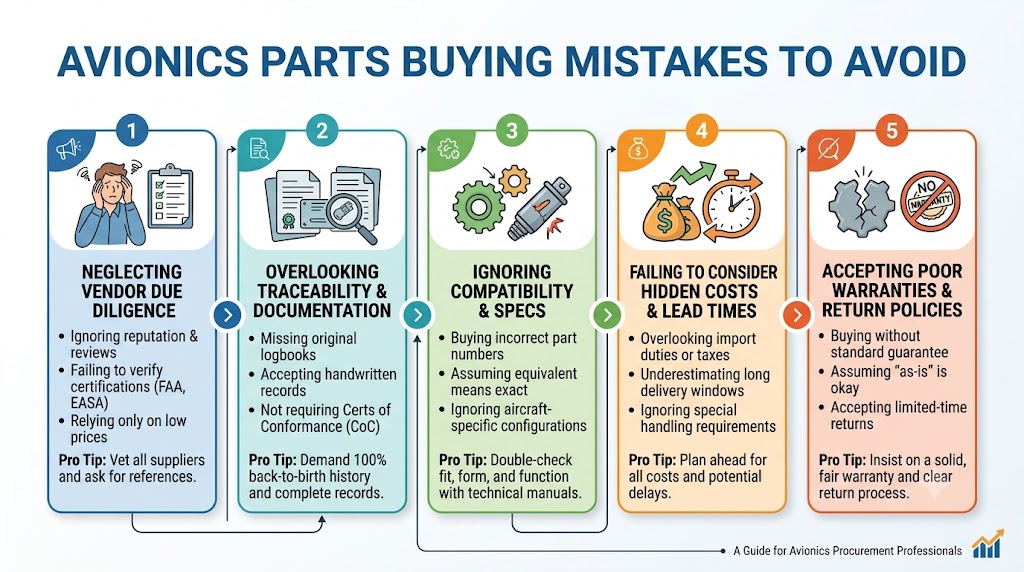
Introduction
Buying avionics parts for an aircraft is not simply a matter of finding a component that fits physically and appears compatible with the existing panel. Avionics equipment sits within interconnected electrical, communication, navigation, flight-display, sensing, and data systems, so a seemingly minor purchasing mistake can create installation, certification, reliability, or maintenance problems later.
The most expensive mistake is often not paying too much for a component. It is buying the wrong component, with incomplete documentation, uncertain history, incompatible interfaces, or unclear eligibility for the intended aircraft and installation.
Whether you are replacing a failed unit, upgrading an aircraft panel, restoring an older aircraft, or supporting an ongoing maintenance program, the purchasing process should begin with the aircraft’s actual requirements and applicable maintenance or installation documentation.
Why Avionics Parts Require More Careful Buying
An avionics component can have several identifiers that appear similar but represent materially different configurations.
For example, a purchasing record may need to distinguish between:
- Part number
- Manufacturer
- Model number
- Serial number
- Modification status
- Software or firmware version
- Configuration
- Applicable service information
- Connector or wiring configuration
- Installation eligibility
- New, overhauled, repaired, inspected, or used condition
- Traceability documentation
Two units that look almost identical externally may not be interchangeable.
A good buying process therefore answers five questions before money changes hands:
- Is this the correct part?
- Is it compatible with this aircraft and installation?
- Is its condition and history acceptable?
- Can its documentation and traceability be verified?
- Can it legally and technically be installed and returned to service under the applicable requirements?
1. Buying by Appearance Instead of Part Number
One of the most common mistakes is purchasing a component because it looks like the unit already installed.
Avionics equipment can have visually similar variants with different:
- Electrical characteristics
- Connector arrangements
- Interface standards
- Software configurations
- Frequencies
- Functional capabilities
- Environmental qualifications
- Installation requirements
Better approach
Start with the existing unit’s identification information and verify the exact part number against the applicable documentation.
Do not rely on:
- photographs
- physical dimensions alone
- seller descriptions
- generic model names
- statements such as “same as your unit”
Part-number verification should come before price comparison.
2. Ignoring Aircraft-Specific Compatibility
A component may technically function but still be unsuitable for a particular aircraft installation.
Compatibility can involve much more than whether the unit receives power.
Consider:
| Compatibility Area | What to Verify |
|---|---|
| Electrical | Voltage, current, protection and wiring requirements |
| Physical | Dimensions, mounting and connector arrangement |
| Data | Digital buses, protocols and interface requirements |
| Navigation | Required sensors and navigation sources |
| Communication | Frequency and communication interfaces |
| Displays | Supported display and data interfaces |
| Antennas | Frequency range, connectors and installation requirements |
| Software | Required software or configuration compatibility |
| Environmental | Applicable temperature, vibration and other requirements |
| Installation | Approved or acceptable installation configuration |
A component should be evaluated as part of the aircraft system, not as an isolated product.
3. Focusing Only on the Lowest Purchase Price
A cheap avionics component can become expensive once installation problems are discovered.
The true cost may include:
Purchase price + inspection + shipping + installation + wiring changes + configuration + testing + troubleshooting + downtime
A lower-priced used component may also carry greater uncertainty regarding condition or remaining serviceability.
Better purchasing question
Instead of asking:
“How much does this unit cost?”
ask:
“What is the expected total cost to obtain a properly documented, serviceable and installable component?”
This produces a much more useful comparison.
4. Buying Used Avionics Without Checking History
Used avionics can be perfectly legitimate purchasing options, but condition and documentation matter.
Before purchasing a used component, investigate what information is available regarding:
- Previous aircraft installation
- Removal reason
- Maintenance history
- Repair history
- Inspection history
- Modifications
- Storage conditions where relevant
- Known defects
- Serviceability status
- Serial-number traceability
- Applicable documentation
A seller who cannot provide meaningful information about the unit’s history may create additional uncertainty.
Red flag
Be cautious when a listing says only:
“Removed from working aircraft.”
That statement does not establish the component’s present condition or installation eligibility.
5. Confusing “Tested” With “Approved for Installation”
This distinction is particularly important.
A seller may state that an avionics unit was:
- powered up
- bench tested
- found operational
- removed from a functioning aircraft
- checked for basic functionality
Those statements do not automatically establish that the component meets every requirement for installation in a particular aircraft.
The purchasing process should distinguish between:
Operational indication
and
documented eligibility and serviceability for the intended installation.
The appropriate maintenance organization or qualified aviation professional should determine what documentation and inspection are required before installation and return to service.
6. Failing to Verify Documentation
Documentation is part of the value of an avionics component.
Depending on the component and jurisdiction, relevant records may include:
- Manufacturer documentation
- Maintenance records
- Inspection documentation
- Release or certification documentation
- Modification records
- Service information
- Installation instructions
- Wiring information
- Configuration information
- Serial-number records
Do not assume that documentation can be obtained later.
Before purchasing, determine:
What documentation comes with the part, and what documentation is still missing?
If required records cannot be established, factor that uncertainty into the purchasing decision.
7. Overlooking Serial Number and Traceability
Part numbers identify a product type. Serial numbers identify the specific unit.
This distinction matters when evaluating a used component.
Verify that:
- The physical serial number matches the documentation.
- The part number matches the advertised unit.
- Labels are legible and consistent.
- Identification plates have not been altered.
- Documentation belongs to the actual unit being purchased.
A mismatch between the physical component and its records should stop the purchasing process until the discrepancy is resolved.
8. Buying a Component Before Checking Installation Requirements
An avionics upgrade may involve much more than replacing one box.
Installation could require consideration of:
- Mounting
- Wiring
- Circuit protection
- Antenna systems
- Cooling
- Grounding
- Configuration
- Software
- Interface equipment
- Existing instruments
- Displays
- Sensors
- Aircraft electrical capacity
A component that looks like a simple replacement can therefore become a broader modification project.
Better workflow
Before purchasing, ask a qualified installer or maintenance professional to review:
- Existing installation
- Proposed component
- Required accessories
- Wiring requirements
- Installation documentation
- Testing requirements
- Aircraft-specific implications
9. Forgetting About Accessories and Required Components
The main avionics unit may not be sufficient.
Depending on the system, you may also need:
- Mounting trays
- Connectors
- Back shells
- Wiring harnesses
- Cooling equipment
- Antennas
- Sensors
- Adapters
- Interface modules
- Configuration equipment
- Installation hardware
A bargain main unit can become less attractive if essential accessories are unavailable or unusually expensive.
Purchasing checklist
Before placing the order, identify:
Unit + mounting hardware + connectors + wiring requirements + accessories + installation requirements + testing requirements.
10. Assuming Older and Newer Units Are Automatically Interchangeable
Avionics technology evolves, and newer equipment may use different interfaces, software, installation procedures, or supporting equipment.
Conversely, replacing an older component with another older component may preserve an outdated architecture that creates future maintenance difficulties.
Before choosing between replacement options, examine:
- Existing system compatibility
- Support availability
- Documentation
- Parts availability
- Installation complexity
- Future maintenance implications
- Required aircraft modifications
The newest component is not automatically the appropriate component, and the cheapest older component is not automatically the most practical replacement.
11. Ignoring Software and Configuration Requirements
Modern avionics frequently depend on software, configuration databases, firmware, or programmed settings.
A physically correct unit may still require:
- Software updates
- Configuration
- Database loading
- Aircraft-specific setup
- Interface configuration
- Functional testing
Before buying, establish whether the component’s current configuration is relevant to your intended installation.
This is especially important when buying used equipment.
12. Neglecting Connector and Wiring Differences
Connector compatibility deserves specific attention.
Two units may appear interchangeable while having different:
- Pin assignments
- Connector types
- Wiring requirements
- Power requirements
- Signal assignments
- Data interfaces
Never assume that an identical-looking connector means identical wiring.
Use the applicable technical documentation rather than relying on photographs or seller claims.
13. Buying From a Seller Without Establishing What Is Actually Included
Online listings can be ambiguous.
For example, “complete unit” could mean only the primary avionics box, while the required tray, connectors, accessories, or documentation are absent.
Before purchasing, clarify:
- Exact part number
- Serial number
- Physical condition
- Included accessories
- Included documentation
- Known defects
- Return terms
- Inspection terms
- Shipping condition
- Any missing components
Get important representations in writing.
14. Not Checking Return or Warranty Conditions
Avionics purchases can involve substantial testing and installation costs.
A component that arrives defective may create additional expense even if the seller eventually accepts a return.
Before buying, understand:
- Return period
- Warranty coverage
- Who pays return shipping
- Whether installation voids the warranty
- Whether testing is covered
- Conditions for warranty claims
- Restocking charges, if applicable
For expensive equipment, these terms can materially affect purchasing risk.
15. Treating “As-Is” Equipment Like Normal Stock
“As-is” is a significant purchasing condition.
It may mean the buyer assumes substantially more risk regarding:
- Serviceability
- Documentation
- Hidden defects
- Testing
- Repairs
- Return eligibility
That does not automatically make an as-is component unsuitable, but the purchase should be treated as a higher-risk transaction.
The price should be evaluated alongside the probability and cost of additional inspection or repair.
16. Ignoring Environmental and Storage History
Avionics equipment can be affected by environmental conditions.
Depending on the component, relevant concerns may include:
- Moisture
- Corrosion
- Excessive heat
- Vibration
- Contamination
- Improper storage
- Physical damage
A component that has been sitting in uncontrolled storage for years deserves different scrutiny from one maintained within a documented aviation maintenance environment.
17. Failing to Inspect Physical Condition
Before accepting a used component, inspect available evidence of:
- Damaged connectors
- Bent or missing pins
- Corrosion
- Cracked housings
- Damaged mounting points
- Missing hardware
- Altered labels
- Signs of overheating
- Unusual repairs
- Fluid contamination
Do not attempt unauthorized internal repairs or modifications merely to make a questionable unit usable.
Inspection and repair should be handled through appropriately qualified personnel and procedures.
18. Buying the Wrong Revision or Configuration
Manufacturers may produce multiple revisions of an avionics component.
Differences may involve:
- Hardware revisions
- Software revisions
- Connector configurations
- Functional options
- Approved installation combinations
- Required supporting equipment
A seller may advertise a broad model name without clearly identifying the exact configuration.
Verify the specific unit, not merely the product family.
19. Ignoring Support and Parts Availability
The purchasing decision should consider what happens after installation.
Ask:
- Is technical documentation available?
- Are qualified repair facilities available?
- Are replacement components obtainable?
- Can the unit be serviced if it fails?
- Are compatible accessories still available?
- Is technical support accessible?
A component that is inexpensive to acquire but difficult to support can increase aircraft downtime later.
20. Failing to Involve the Installer Early
One of the most preventable purchasing mistakes is buying equipment first and asking an avionics shop about installation afterward.
The installer can identify issues such as:
- Compatibility problems
- Required wiring changes
- Missing accessories
- Installation limitations
- Testing requirements
- Configuration requirements
- Aircraft-specific considerations
For significant avionics work, installation planning should happen before the purchase whenever practical.
A Better Avionics Parts Buying Process
A disciplined buying workflow can reduce most avoidable problems.
Step 1: Define the Requirement
Write down:
- Aircraft
- Existing equipment
- Intended function
- Replacement or upgrade objective
- Required interfaces
- Operational requirements
- Known installation constraints
Step 2: Identify the Exact Component
Record:
- Manufacturer
- Model
- Part number
- Serial number, if replacing an existing unit
- Relevant configuration
- Required accessories
Avoid relying on generic descriptions.
Step 3: Verify Compatibility
Check applicable technical documentation and confirm:
- Electrical compatibility
- Mechanical compatibility
- Interface compatibility
- Installation requirements
- Supporting equipment
- Configuration requirements
Step 4: Evaluate Condition
Classify the component accurately:
| Condition | Purchasing Question |
|---|---|
| New | Is documentation complete? |
| Factory/authorized overhaul | Who performed the work and what records accompany it? |
| Repaired | What work was performed and what documentation exists? |
| Inspected | What inspection was completed? |
| Used/serviceable | What evidence supports serviceability? |
| As-is | What additional risk and inspection cost should be expected? |
Do not treat these conditions as equivalent.
Step 5: Verify Documentation and Traceability
Match:
Physical unit → Part number → Serial number → Records
Any unexplained mismatch should be resolved before purchase.
Step 6: Calculate Total Acquisition Cost
Consider:
- Component price
- Shipping
- Inspection
- Repair
- Accessories
- Installation
- Wiring
- Configuration
- Testing
- Potential downtime
This produces a more realistic purchasing decision than comparing sticker prices.
Step 7: Have the Installation Reviewed
For aircraft-specific work, involve an appropriately qualified avionics technician, maintenance organization, or other responsible aviation professional before committing to a component that may require modification.
Step 8: Establish Acceptance Criteria
Before purchase, define what would make the component acceptable.
For example:
- Correct part number
- Correct configuration
- Matching serial number and documentation
- Required records present
- No unacceptable physical damage
- Compatible with the intended installation
- Suitable warranty or return terms
Avionics Buying Decision Matrix
| Buying Factor | Low Risk Indicator | Higher Risk Indicator |
|---|---|---|
| Part identification | Exact part and serial verified | Generic model description |
| Documentation | Complete and traceable | Missing or unclear |
| Condition | Documented service history | Unknown history |
| Compatibility | Verified against installation | Seller assumption |
| Configuration | Confirmed | Unspecified |
| Accessories | Complete | Missing critical items |
| Seller | Established aviation supplier | Unverified source |
| Warranty | Clear terms | As-is |
| Return policy | Clearly documented | No practical return |
| Installation | Reviewed beforehand | Purchased without review |
| Support | Repair/support available | Obsolete or unsupported |
| Cost | Total cost understood | Price-only comparison |
Red Flags in Avionics Parts Listings
Be particularly careful when a listing contains several of these characteristics:
- “Untested”
- “As removed”
- “As-is”
- “No returns”
- Missing part number
- Missing serial number
- Poor or incomplete photographs
- Unclear documentation
- Claims of compatibility without technical evidence
- Unusually low price
- Altered or damaged identification labels
- “Powers on” presented as proof of serviceability
- No explanation of removal history
- Seller unable to answer basic technical questions
One red flag does not necessarily make a component unusable. Multiple unresolved issues, however, should substantially increase purchasing scrutiny.
Questions to Ask Before Buying
Before committing to an avionics component, ask the seller:
- What is the exact manufacturer part number?
- What is the serial number?
- What is the stated condition?
- What documentation accompanies the unit?
- Is the documentation traceable to this serial number?
- Why was the unit removed?
- Was it repaired or modified?
- What accessories are included?
- Are the connectors and mounting hardware included?
- What software or configuration information is available?
- Are there known defects?
- What warranty or return terms apply?
- Has the unit been stored under appropriate conditions?
- Can additional photographs or records be provided?
- Has compatibility with the intended aircraft installation been verified?
When Buying Used Makes Sense
Used avionics can make sense when the buyer has a well-defined requirement and can verify the unit’s identity, condition, documentation, and compatibility.
It can be particularly practical when:
- The aircraft already uses the same component.
- A documented replacement is available.
- The installation does not require unnecessary redesign.
- Support and repair capability remain available.
- The price difference from a new unit is meaningful.
- The purchasing risk is understood.
The objective should not be “buy used at any cost.”
The objective should be “buy the right component with an acceptable level of technical and documentation risk.”
When a New Component May Be More Appropriate
A new component may be preferable when:
- Documentation requirements are stringent.
- Reliability is particularly important.
- The existing equipment is obsolete.
- Used examples have uncertain history.
- The installation is part of a broader modernization.
- Long-term support is important.
- The cost of troubleshooting an uncertain used unit would be substantial.
The decision should be based on the complete installation lifecycle rather than purchase price alone.
Maintenance and Lifecycle Considerations
Buying the component is only the beginning.
A responsible procurement process should consider what happens after installation.
Maintain
Keep records of:
- Part numbers
- Serial numbers
- Installation details
- Relevant maintenance documentation
- Configuration information
- Repairs
- Inspections
- Modifications
Monitor
Watch for:
- Recurring failures
- Intermittent faults
- Increasing maintenance requirements
- Obsolescence
- Availability problems
Plan
For critical equipment, understand:
- Replacement options
- Repair facilities
- Lead times
- Alternative configurations
- Future upgrade paths
This turns avionics procurement from a one-time transaction into lifecycle management.
Practical Pre-Purchase Checklist
Before purchasing an avionics part, verify:
- Aircraft requirement is clearly defined
- Exact part number is confirmed
- Serial number is recorded where applicable
- Configuration or revision is verified
- Electrical compatibility is checked
- Mechanical compatibility is checked
- Interfaces are compatible
- Required accessories are identified
- Documentation is available
- Traceability is established
- Condition is clearly stated
- Repair/inspection history is reviewed where available
- Seller’s return terms are understood
- Warranty terms are understood
- Installation requirements are reviewed
- Qualified installation support is identified
- Required testing or configuration is understood
- Total acquisition and installation cost is estimated
- Long-term support is considered
The Most Important Buying Principle
The safest purchasing mindset is:
Do not buy an avionics part because it looks right or because it is cheap. Buy it because its identity, compatibility, condition, documentation, and intended installation have been properly verified.
That principle prevents many downstream problems.
A slightly more expensive component with clear documentation and verified compatibility can be a more practical purchase than a cheaper unit that creates uncertainty during installation.
Conclusion
Avionics parts purchasing requires more than comparing prices and matching model names. The exact part number, configuration, condition, documentation, traceability, compatibility, accessories, installation requirements, and long-term support all deserve attention. Used equipment can be useful, but its history and records should be evaluated carefully. Most importantly, purchasing decisions should be coordinated with the requirements of the actual aircraft installation rather than made from a seller’s listing alone. A disciplined verification process reduces the risk of buying a component that cannot be properly installed, supported, or returned to service.

