
Introduction
Aircraft engine reliability is one of the most important factors in aviation safety and operational performance. Whether an aircraft is used for private flying, flight training, commercial operations, or experimental aviation, maintaining the engine in proper condition is essential for dependable performance.
Unlike many mechanical systems, aircraft engines operate under demanding conditions. They experience high temperatures, continuous movement, vibration, and changing operating environments. Because of this, regular inspection, preventive maintenance, and proper parts planning are necessary to identify potential issues before they become serious problems.
An organized aircraft engine parts checklist helps aircraft owners, technicians, and maintenance teams track important components, plan inspections, manage replacements, and reduce unexpected downtime.
Proper maintenance planning is not only about fixing problems after they occur. It is about creating a structured approach that supports safety, reliability, and efficient aircraft operation.
Why Aircraft Engine Maintenance Planning Matters
Aircraft engine maintenance planning helps ensure that critical components remain reliable throughout their operating life.
A well-organized maintenance approach provides several benefits:
- Improves aircraft reliability
- Helps identify wear and damage early
- Reduces unexpected maintenance delays
- Supports safer flight operations
- Improves record management
- Helps plan parts availability
Without proper planning, small issues can develop into larger maintenance challenges. Regular inspections and accurate documentation allow technicians to monitor engine condition and make informed decisions.
Maintenance planning also helps aircraft operators prepare for future requirements by ensuring necessary parts and resources are available when needed.
Understanding Aircraft Engine Components
Aircraft engines contain many interconnected components that work together to produce power and support flight operations. Each part plays an important role, and regular inspection helps maintain reliable performance.
1. Engine Core Components
The engine core contains the primary mechanical components responsible for generating power.
Important components include:
Cylinders
Cylinders contain the combustion process that creates engine power.
Maintenance teams inspect cylinders for:
- Wear
- Damage
- Compression issues
- Operating condition
Proper cylinder maintenance helps maintain engine efficiency.
Pistons
Pistons move inside cylinders and transfer combustion energy into mechanical movement.
Inspection focuses on:
- Wear condition
- Movement quality
- Signs of damage
Crankshaft
The crankshaft converts piston movement into rotational power.
Maintenance checks may include:
- Surface condition
- Alignment
- Wear monitoring
Connecting Rods
Connecting rods transfer movement between pistons and the crankshaft.
Proper inspection helps ensure reliable engine operation.
Bearings
Bearings support moving components and reduce friction.
Maintenance teams monitor:
- Lubrication condition
- Wear
- Operating performance
2. Fuel System Components
The fuel system delivers the correct amount of fuel needed for engine operation.
Important components include:
Fuel Pumps
Fuel pumps maintain proper fuel delivery to the engine.
Inspection focuses on:
- Performance
- Leaks
- Operating condition
Fuel Injectors
Fuel injectors control fuel distribution into the engine.
Maintenance helps ensure:
- Proper fuel flow
- Efficient combustion
- Reliable engine operation
Carburetors or Fuel Control Systems
These components regulate the fuel and air mixture.
Proper maintenance supports consistent engine performance.
Fuel Lines and Filters
Fuel lines transport fuel, while filters remove contaminants.
Regular inspection helps prevent fuel system problems.
3. Ignition System Components
The ignition system starts and controls the combustion process.
Important components include:
Spark Plugs
Spark plugs create the ignition needed for combustion.
Maintenance includes:
- Condition inspection
- Cleaning when applicable
- Replacement planning
Magnetos
Magnetos provide electrical energy for ignition systems.
Technicians inspect them for proper operation and reliability.
Ignition Leads
Ignition leads transfer electrical energy to spark plugs.
Inspection helps identify:
- Damage
- Wear
- Connection problems
4. Lubrication System Components
Engine lubrication reduces friction and protects moving parts.
Important lubrication components include:
Oil Pumps
Oil pumps circulate lubricant throughout the engine.
Proper operation helps protect internal components.
Oil Filters
Oil filters remove contaminants from engine oil.
Regular replacement helps maintain clean lubrication.
Oil Lines
Oil lines transport lubricant between engine components.
Inspection helps identify leaks or damage.
Oil Coolers
Oil coolers help maintain appropriate oil temperature during operation.
5. Cooling System Components
Engine temperature management is essential for safe operation.
Cooling components help prevent excessive heat buildup.
Maintenance teams inspect:
- Cooling passages
- Temperature-related components
- Cooling system condition
Proper cooling helps protect engine performance and reliability.
6. Air Intake Components
The air intake system supplies air required for combustion.
Important parts include:
Air Filters
Air filters prevent dust and contaminants from entering the engine.
Maintenance involves:
- Inspection
- Cleaning
- Replacement when required
Intake Components
Intake systems must remain clean and properly connected to support efficient engine operation.
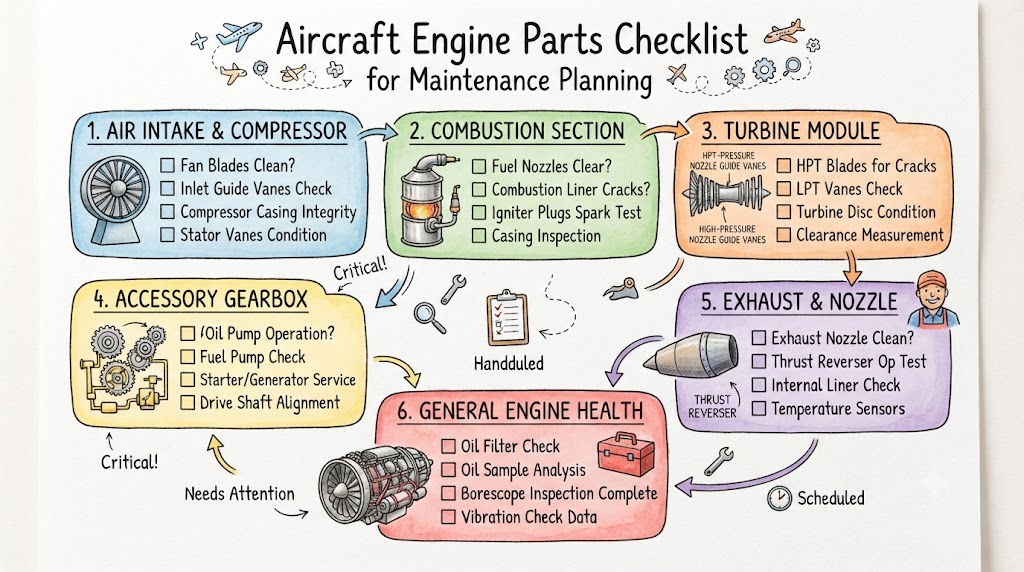
Aircraft Engine Parts Maintenance Checklist
A structured checklist helps maintenance teams organize inspections and track component conditions.
Regular Inspection Items
Engine Exterior Inspection
Check for:
- Visible damage
- Loose components
- Leaks
- Abnormal conditions
Oil Level and Condition Check
Monitor:
- Oil quantity
- Oil quality
- Signs of contamination
Filter Inspection
Review:
- Oil filters
- Fuel filters
- Air filters
Fuel System Inspection
Check:
- Fuel lines
- Connections
- Fuel delivery components
Ignition System Check
Inspect:
- Spark plugs
- Ignition components
- Electrical connections
Cooling System Review
Monitor:
- Temperature-related issues
- Cooling components
- Proper airflow
Leak Inspection
Identify possible leaks involving:
- Oil
- Fuel
- Hydraulic fluids
Component Wear Assessment
Evaluate:
- Moving parts
- Connections
- Engine condition
Engine Parts Replacement Planning
Effective replacement planning helps prevent unexpected aircraft downtime.
Manufacturer Guidelines
Aircraft engine maintenance should follow approved guidance provided by the engine manufacturer and applicable aviation regulations.
Maintenance planning should consider:
- Inspection schedules
- Approved procedures
- Recommended replacement practices
Operating Conditions
Engine component life can vary depending on:
- Flight hours
- Operating environment
- Aircraft usage
- Maintenance quality
Aircraft used frequently or under demanding conditions may require closer monitoring.
Parts Availability
Maintaining access to required components helps reduce maintenance delays.
Important considerations include:
- Reliable suppliers
- Correct part identification
- Availability of commonly needed items
Common Aircraft Engine Parts That Require Regular Attention
Filters
Filters help protect engine systems from contamination.
Common examples include:
- Oil filters
- Air filters
- Fuel filters
Spark Plugs
Spark plugs require regular inspection to maintain proper ignition performance.
Belts and Hoses
Belts and hoses should be checked for:
- Wear
- Cracks
- Damage
- Aging
Seals and Gaskets
Seals and gaskets help prevent fluid leaks and maintain system integrity.
Bearings and Moving Components
Moving parts require proper lubrication and inspection to prevent excessive wear.
Aircraft Engine Parts Inventory Management Tips
Maintain Accurate Records
Proper documentation helps track:
- Part numbers
- Installation history
- Inspection records
- Replacement dates
Accurate records support better maintenance decisions.
Use Quality Parts
Using suitable and approved components helps maintain aircraft reliability.
Maintenance teams should confirm:
- Correct specifications
- Proper compatibility
- Reliable sourcing
Plan Ahead
Advance planning helps avoid delays caused by unavailable components.
Good inventory planning includes:
- Monitoring frequently used parts
- Ordering components before urgent needs
- Maintaining organized storage
Organize Storage
Aircraft parts should be stored properly to protect them from:
- Contamination
- Moisture
- Damage
Signs That Aircraft Engine Parts May Need Inspection
Certain signs may indicate that an engine requires additional attention.
Common warning indicators include:
- Unusual engine sounds
- Reduced performance
- Increased vibration
- Oil leaks
- Abnormal temperature readings
- Difficult engine starting
When these signs appear, proper inspection should be performed by qualified maintenance personnel.
Aircraft Engine Parts Checklist Comparison Table
| Engine Part | Function | Maintenance Focus |
|---|---|---|
| Spark Plugs | Support ignition process | Inspection and replacement planning |
| Oil Filter | Removes contaminants from oil | Regular monitoring and replacement |
| Fuel Pump | Delivers fuel to engine | Performance and leak checks |
| Air Filter | Protects engine air intake | Cleaning and replacement |
| Bearings | Support moving components | Wear and lubrication inspection |
| Seals | Prevent fluid leakage | Condition monitoring |
Common Maintenance Planning Mistakes
Ignoring Maintenance Records
Incomplete records can make it difficult to understand component history and future requirements.
Delaying Small Repairs
Minor issues can become more complicated if ignored.
Using Incorrect Parts
Incorrect components may affect aircraft performance and reliability.
Poor Inventory Planning
Missing important parts can increase aircraft downtime.
Not Following Manufacturer Guidance
Following approved maintenance procedures is essential for safe aircraft operation.
Benefits of a Proper Aircraft Engine Parts Checklist
A well-maintained checklist helps organizations achieve:
Better Maintenance Organization
Technicians can clearly track inspections and replacement requirements.
Reduced Downtime
Planning parts availability helps aircraft return to service faster.
Improved Safety Management
Regular inspections help identify possible problems early.
Better Cost Control
Preventive planning can reduce unexpected maintenance challenges.
Improved Aircraft Reliability
Consistent maintenance supports dependable engine performance.
Future Trends in Aircraft Engine Maintenance
Aircraft maintenance continues to evolve with new technologies and improved monitoring systems.
Future trends include:
Digital Maintenance Tracking
Electronic records help maintenance teams manage inspections and component history more efficiently.
Predictive Maintenance Technology
Advanced monitoring systems can help identify possible issues before failures occur.
Improved Engine Monitoring
Modern aircraft systems provide better information about engine condition and performance.
Data-Driven Maintenance Planning
Using operational data helps organizations create more effective maintenance strategies.
Frequently Asked Questions
1. Why is an aircraft engine parts checklist important?
An aircraft engine parts checklist helps maintenance teams organize inspections, track components, and plan replacements effectively.
2. What are the main parts of an aircraft engine?
Major engine components include cylinders, pistons, crankshafts, fuel systems, ignition systems, lubrication systems, and cooling components.
3. How often should aircraft engine parts be inspected?
Inspection frequency depends on aircraft type, engine model, operating conditions, and manufacturer guidelines.
4. Why is preventive aircraft engine maintenance important?
Preventive maintenance helps identify potential issues early and supports safer aircraft operation.
5. Which engine parts require regular replacement?
Parts such as filters, spark plugs, seals, and certain wear components commonly require regular inspection and replacement planning.
6. How do maintenance teams track aircraft engine parts?
Teams use maintenance records, part numbers, inspection logs, and aircraft documentation.
7. What factors affect aircraft engine part life?
Factors include flight hours, operating conditions, maintenance quality, and engine usage.
8. How does proper parts inventory reduce downtime?
Maintaining available parts helps prevent delays when maintenance work is required.
9. Why is using compatible aircraft engine parts important?
Compatible parts ensure proper operation, reliability, and safety.
10. How can aircraft owners improve maintenance planning?
Aircraft owners can improve planning by maintaining accurate records, following maintenance schedules, and working with qualified professionals.
Conclusion
Aircraft engine maintenance planning requires careful organization, accurate documentation, and proper understanding of engine components. A detailed aircraft engine parts checklist helps owners, operators, and technicians monitor important systems and prepare for future maintenance needs. By focusing on preventive inspections, reliable parts management, and proper maintenance procedures, aircraft operators can improve engine reliability and reduce unexpected downtime. A structured approach to aircraft engine parts planning supports safer operations, better performance, and a more efficient aviation maintenance process.

