
Introduction
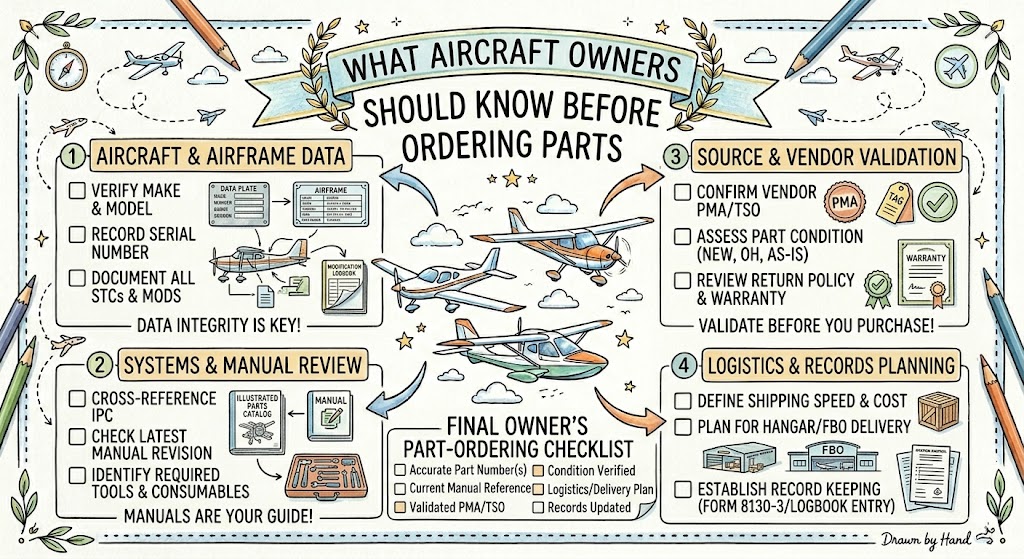
Ordering aircraft parts is very different from buying ordinary mechanical parts. In aviation, every component matters because even a small part can affect aircraft safety, reliability, performance, and airworthiness. Aircraft owners must think beyond price and availability. They need to check compatibility, certification, documentation, supplier credibility, condition, warranty, lead time, and maintenance requirements before placing an order.
Many aircraft owners face delays or extra costs because they order the wrong part, miss important paperwork, or choose a supplier without proper verification. A part may look correct in a photo, but if the part number, serial reference, certification, or fitment does not match the aircraft, it may not be suitable for installation. This can delay maintenance, increase aircraft downtime, and create inspection problems.
For private aircraft owners, small fleet operators, maintenance planners, and first-time aircraft part buyers, having a clear ordering process is essential. This guide explains what aircraft owners should know before ordering parts and provides a practical checklist to help avoid common mistakes.
Why Aircraft Parts Ordering Requires Careful Planning
Aircraft parts are safety-critical components. Unlike general automotive or industrial parts, aviation parts must meet strict requirements for fitment, quality, documentation, traceability, and airworthiness. Ordering the wrong component can create serious issues for the owner and maintenance team.
A wrong aircraft part can lead to:
- Maintenance delays
- Extra inspection work
- Installation problems
- Return or restocking charges
- Aircraft downtime
- Compliance concerns
- Increased repair cost
- Safety risks
- Logbook documentation issues
Even a small part such as a seal, bolt, bracket, filter, switch, cable, sensor, or fastener may have specific requirements. Aircraft parts are often tied to exact model numbers, serial number ranges, engine types, service bulletins, and approved maintenance manuals. That is why careful planning is important before placing any order.
Aircraft owners should treat parts ordering as part of aircraft maintenance planning. The goal is not only to buy a part, but to buy the correct, documented, suitable, and installable part.
Know Your Aircraft Details Before Ordering
Before contacting a supplier, aircraft owners should collect basic aircraft information. This helps the supplier, mechanic, or maintenance provider confirm the correct part.
Aircraft Make and Model
The aircraft make and model are the starting point for part identification. Similar aircraft models may use different parts depending on configuration, production batch, or upgrade history.
Aircraft Serial Number
The serial number is very important because some parts are applicable only to specific serial number ranges. A part that fits one aircraft model may not fit another aircraft of the same model if the serial number range is different.
Engine Type
Aircraft engines have their own parts, accessories, filters, mounts, hoses, sensors, and hardware. Confirming the engine type helps avoid ordering the wrong engine-related component.
Airframe Configuration
Aircraft may have different configurations based on modifications, avionics upgrades, interior layout, landing gear type, or optional equipment. These details can affect part compatibility.
Existing Part Number
If the old part is available, note the part number carefully. Do not rely only on appearance. Many aviation parts look similar but have different specifications.
Maintenance Manual Reference
The aircraft maintenance manual or illustrated parts catalog may provide the correct part reference. Aircraft owners should ask their mechanic or maintenance provider to confirm the manual reference before ordering.
Logbook or Maintenance Record Details
Maintenance records may show previous part replacements, modifications, service bulletins, or approved alternatives. Reviewing these records can prevent ordering mistakes.
Understand the Part Number and Fitment Requirements
Part numbers are extremely important in aviation. Aircraft owners should never order parts based only on photos, general descriptions, or assumptions. The correct part number helps confirm whether the component is approved and suitable for the aircraft.
OEM Part Numbers
OEM means Original Equipment Manufacturer. An OEM part number refers to a part produced or specified by the original manufacturer. OEM parts are commonly used when owners want factory-standard replacement components.
Alternate Part Numbers
Some parts may have approved alternate part numbers. These alternatives may be acceptable if they are properly documented and approved for the aircraft.
Superseded Part Numbers
Aircraft parts may be updated over time. A manufacturer may replace an older part number with a newer one. This is called a superseded part number. Before ordering, aircraft owners should confirm whether the older number is still valid or has been replaced.
PMA Parts
PMA parts are parts manufactured under approved aviation manufacturing standards. They may be suitable alternatives in some cases, but aircraft owners should always confirm acceptance with their mechanic or maintenance provider.
Compatibility With Aircraft Model
Part compatibility depends on aircraft model, serial number, configuration, and maintenance approval. Even if a supplier says the part is compatible, the final confirmation should come from qualified maintenance personnel.
Mechanic Confirmation
A certified mechanic or maintenance provider should verify the part number before purchase. This helps avoid wrong-fitment problems and supports proper maintenance documentation.
Check Certification and Documentation
Documentation is one of the most important factors when ordering aircraft parts. A part without proper paperwork may create installation, inspection, or resale problems. Aircraft owners should ask what documents come with the part before buying.
Airworthiness Documentation
Airworthiness documentation helps show that the part is suitable for aviation use. Depending on the part type and condition, different documents may be required.
Traceability Records
Traceability means the history of the part can be tracked. It may include where the part came from, previous installation details, maintenance actions, or supplier records. Traceability is important for safety and compliance.
Certificate of Conformity
A certificate of conformity may confirm that the part meets specified manufacturing or quality requirements. Availability depends on part type and supplier.
Release Certificates
Some parts may come with release certificates or approval documents. These documents help support proper installation and maintenance records.
Supplier Invoice and Documentation
Keep the supplier invoice, packing slip, certificate copies, and all related documents. These may be needed for maintenance records, warranty claims, or future sale of the aircraft.
Maintenance Record Support
After installation, the mechanic should update aircraft maintenance records. Proper documentation helps show that the aircraft has been maintained responsibly.
New, Used, Overhauled, Repaired, or Exchange Parts
Aircraft parts may be sold in different conditions. Before ordering, aircraft owners should clearly understand what they are buying.
New Parts
New parts are unused components. They may come from the manufacturer, distributor, or approved supplier. New parts are often preferred for critical replacements, but they may cost more and have longer lead times.
Used or Serviceable Parts
Used or serviceable parts have been previously installed or stored but are considered usable. Documentation and condition reports are very important when buying used aircraft parts.
Overhauled Parts
Overhauled parts have been disassembled, inspected, repaired if needed, tested, and returned to serviceable condition according to approved procedures. Overhauled parts can be useful for components such as accessories, instruments, pumps, or mechanical assemblies.
Repaired Parts
Repaired parts have undergone specific repair work to restore serviceability. The repair details and approval documents should be reviewed carefully.
Exchange Parts
Exchange parts are often used when an owner sends back an old core part and receives a replacement unit. Exchange programs may reduce cost, but owners should understand core return rules, timelines, and charges.
Verify Supplier Reliability
Choosing the right supplier is as important as choosing the right part. A reliable aviation parts supplier should be transparent, responsive, and able to provide clear information.
Aviation Industry Experience
Suppliers with aviation experience understand the importance of documentation, part numbers, condition codes, packaging, and urgent maintenance needs.
Clear Part Descriptions
The supplier should clearly describe the part condition, part number, applicability, available documents, warranty, and lead time.
Documentation Availability
Before ordering, ask what documents are included. If documentation is missing or unclear, discuss the risk with your mechanic.
Return Policy
Aircraft parts can be difficult to return, especially electrical parts, special-order parts, or opened components. Review the return policy before buying.
Quality Control Process
A good supplier should have a basic quality control process for checking part condition, packaging, and documentation.
Customer Support
Aircraft owners may need support before and after purchase. A responsive supplier can help resolve questions about shipping, documentation, or order status.
Transparent Pricing
The supplier should explain the part price, shipping cost, taxes, customs duties, core charges, and any additional fees.
Shipping Capability
Aircraft parts must be packed properly. Fragile instruments, avionics, seals, hoses, and precision parts require careful handling.
Confirm Availability and Lead Time
Aircraft parts are not always available immediately. Some parts may be in stock, while others may be backordered or require manufacturing time. Owners should confirm availability before planning maintenance.
Stock Availability
Ask whether the part is physically in stock or only listed in a catalog. A listed part does not always mean immediate availability.
Backorders
If the part is backordered, ask for an estimated timeline. Keep in mind that estimates may change depending on supplier or manufacturer delays.
Manufacturing Delays
Some parts may need to be manufactured or sourced from specialized suppliers. This can increase lead time.
International Shipping
International orders may take longer due to export rules, shipping schedules, customs clearance, and documentation requirements.
Customs Clearance
Aircraft parts shipped across borders may need customs processing. Owners should plan for possible delays and additional charges.
Aircraft-on-Ground Situations
If the aircraft is grounded, part lead time becomes more urgent. In such cases, owners should communicate clearly with the supplier and maintenance provider to avoid unnecessary downtime.
Review Return and Warranty Policies
Before ordering aircraft parts, aircraft owners should understand return and warranty terms. This is especially important for expensive, electrical, avionics, or special-order items.
Wrong Part Risk
Even with careful checking, wrong part orders can happen. A clear return policy helps reduce financial loss.
Fitment Issues
Sometimes a part number may appear correct but does not fit due to configuration or modification differences. Ask whether the supplier accepts returns for fitment issues.
Damaged Shipment
Parts can be damaged during shipping. Owners should inspect packages immediately and report damage quickly.
Limited Return Windows
Some suppliers allow returns only within a short time. Review the return period before ordering.
Restocking Fees
Some returns may involve restocking fees. This cost should be understood in advance.
Warranty Conditions
Warranty may depend on part condition, installation by qualified personnel, proper documentation, and usage. Always ask what the warranty covers and what it does not cover.
Understand Total Cost Before Buying
The lowest listed part price is not always the best deal. Aircraft owners should calculate the total cost before buying.
Part Cost
This is the base price of the component. Compare the price with condition, documentation, and supplier reliability.
Shipping Cost
Aircraft parts may require special packaging or faster shipping. Large or fragile parts can be expensive to ship.
Customs or Import Duties
International purchases may include customs duties, taxes, handling charges, or import fees.
Inspection Cost
Some parts may need inspection before installation. This can add to the total maintenance cost.
Installation Labor
A mechanic or maintenance provider will need time to install, test, and document the part. Labor cost should be included in planning.
Documentation Fees
Some suppliers may charge additional fees for special documentation or paperwork support.
Downtime Cost
If the aircraft is unavailable for use, downtime can create financial or operational impact. This is especially important for business or fleet aircraft.
Work With a Certified Mechanic or Maintenance Provider
Aircraft owners should involve a qualified mechanic or maintenance provider before ordering parts. Even experienced owners can miss technical details that affect fitment or approval.
Confirming Correct Part Number
A mechanic can check the aircraft manual, part catalog, previous records, and installation requirements before purchase.
Checking Airworthiness Requirements
A mechanic can help confirm whether the part is acceptable for installation and meets aircraft maintenance requirements.
Reviewing Service Bulletins
Some parts may be affected by service bulletins, manufacturer updates, or recommended replacements. Maintenance professionals can review these details.
Ensuring Correct Installation
Aircraft parts must be installed correctly. Improper installation can affect safety and performance.
Updating Maintenance Records
After installation, aircraft records must be updated properly. A mechanic helps ensure documentation is complete and accurate.
Avoid Common Mistakes When Ordering Aircraft Parts
Many ordering problems can be avoided with better planning. Aircraft owners should watch for these common mistakes.
Ordering by Photo Only
Photos are not enough to confirm fitment. Always verify the part number and aircraft compatibility.
Ignoring Part Number Changes
Old part numbers may be superseded. Confirm whether the current replacement part number is correct.
Not Checking Documentation
A part without proper paperwork may create inspection or installation issues.
Choosing the Cheapest Supplier Without Verification
Low price can be risky if the supplier lacks documentation, support, or quality control.
Forgetting Shipping Time
Aircraft parts may take days or weeks to arrive. Always check lead time before scheduling maintenance.
Not Confirming Compatibility
Compatibility should be confirmed by aircraft records, manuals, and maintenance professionals.
Not Checking Return Policies
Some aircraft parts may not be returnable. Always review return terms before purchase.
Ordering Without Mechanic Approval
A mechanic should confirm the part before purchase, especially for critical or expensive components.
Ignoring Total Cost
Shipping, customs, inspection, installation, and downtime can make a cheap part more expensive overall.
Poor Recordkeeping
Keep all invoices, certificates, packing documents, and maintenance records organized.
Aircraft Parts Ordering Checklist
| Checklist Item | Why It Matters | Status |
|---|---|---|
| Confirm aircraft make and model | Helps identify the correct part category | Pending |
| Confirm aircraft serial number | Ensures part applicability by aircraft range | Pending |
| Check engine type | Prevents ordering wrong engine-related parts | Pending |
| Verify existing part number | Reduces wrong-fitment risk | Pending |
| Review maintenance manual | Confirms approved part reference | Pending |
| Ask mechanic for approval | Supports safety and compliance | Pending |
| Confirm part condition | Helps compare new, used, overhauled, or repaired options | Pending |
| Check documentation | Supports installation and maintenance records | Pending |
| Verify supplier reliability | Reduces risk of poor-quality parts or missing paperwork | Pending |
| Confirm lead time | Helps plan maintenance schedule | Pending |
| Review return policy | Protects against wrong part or fitment issues | Pending |
| Review warranty terms | Clarifies coverage after purchase | Pending |
| Calculate total cost | Includes shipping, customs, labor, and downtime | Pending |
| Inspect part on arrival | Helps identify damage or mismatch early | Pending |
| Store records safely | Supports future maintenance and aircraft value | Pending |
Questions to Ask Before Placing an Aircraft Parts Order
Before confirming your order, ask these practical questions:
- Is this the correct part number for my aircraft?
- Is the part compatible with my aircraft model and serial number?
- Has the part number been superseded?
- Is the part new, used, overhauled, repaired, or exchange?
- What documentation comes with the part?
- Is the part traceable?
- Is the part currently in stock?
- What is the estimated lead time?
- What is the return policy?
- Is there a warranty?
- Are there restocking fees?
- Are shipping, customs, or handling charges extra?
- Can my mechanic verify this part before purchase?
- What happens if the part arrives damaged?
- Will this part require additional inspection before installation?
How to Inspect Aircraft Parts After Delivery
After receiving the part, do not rush directly to installation. Inspect the package and documents carefully.
Check Packaging
Look for signs of damage, moisture, poor handling, or broken seals. Report damaged packaging quickly.
Match the Part Number
Compare the delivered part number with the order details, maintenance manual reference, and mechanic-approved number.
Review Documents
Check certificates, invoice, traceability records, and any release paperwork. Keep copies for maintenance records.
Inspect Physical Condition
Look for visible cracks, corrosion, missing hardware, damaged connectors, worn surfaces, or signs of mishandling.
Confirm With Mechanic
Before installation, allow the mechanic or maintenance provider to review the part and documentation.
Importance of Recordkeeping for Aircraft Owners
Good recordkeeping protects the aircraft owner. Aircraft maintenance history is important for safety, inspections, resale value, and future troubleshooting.
Aircraft owners should keep:
- Supplier invoices
- Certificates and release documents
- Shipping records
- Warranty documents
- Maintenance logbook entries
- Installation records
- Mechanic notes
- Returned core documentation if applicable
Well-maintained records show that the aircraft has been cared for properly. They also help future mechanics understand what has been installed and when.
Safety Considerations Before Installing Aircraft Parts
Aircraft parts should never be installed casually. Every installation should support safe aircraft operation.
Aircraft owners should make sure:
- The part is correct
- Documentation is complete
- The mechanic has reviewed the part
- The aircraft manual supports the installation
- Required inspections are completed
- Maintenance records are updated
- Any testing after installation is performed properly
Safety should always be more important than speed or cost savings.
FAQs
1- Why is documentation important when ordering aircraft parts?
Documentation helps prove the part’s identity, condition, source, and suitability for aviation use. Without proper paperwork, a part may create installation, inspection, or maintenance record issues. Aircraft owners should always ask what documents are included before purchasing.
2- Can aircraft owners order parts without a mechanic?
Aircraft owners can contact suppliers and request quotes, but it is best to involve a qualified mechanic before ordering. A mechanic can confirm the correct part number, compatibility, documentation needs, and installation requirements. This reduces the chance of ordering the wrong part.
3- What is a part number in aviation?
A part number is a unique identification code used to identify a specific aircraft component. It helps confirm the exact part required for an aircraft, engine, or system. Because many aviation parts look similar, the part number is more reliable than appearance.
4- What is the difference between new and overhauled aircraft parts?
New parts are unused components, while overhauled parts have been inspected, repaired if needed, tested, and returned to serviceable condition. Overhauled parts may be cost-effective for certain components, but proper documentation is essential.
5- Are used aircraft parts safe?
Used aircraft parts can be safe if they are serviceable, properly documented, traceable, and approved for installation. The condition and paperwork should be reviewed carefully by a qualified maintenance professional before use.
6- What should I check before choosing a parts supplier?
Check the supplier’s aviation experience, part descriptions, documentation availability, return policy, warranty terms, customer support, quality control process, and shipping capability. A reliable supplier should provide clear information before purchase.
7- Why do aircraft parts sometimes have long lead times?
Aircraft parts may have long lead times because of limited stock, backorders, specialized manufacturing, international shipping, customs clearance, or high demand. Owners should confirm availability before scheduling maintenance.
8- What happens if I order the wrong aircraft part?
If you order the wrong part, installation may be delayed, return fees may apply, and the aircraft may remain out of service longer. Some parts may not be returnable, especially special-order or electrical components. Always confirm fitment before buying.
9- Should I choose the cheapest aircraft part?
The cheapest option is not always the best choice. Aircraft owners should consider documentation, condition, supplier reliability, warranty, lead time, and total cost. A low-cost part without proper paperwork may become expensive later.
10- How can I avoid aircraft parts ordering mistakes?
You can avoid mistakes by confirming aircraft details, verifying part numbers, checking documentation, involving a mechanic, reviewing supplier reliability, understanding return policies, and keeping all records organized. A structured checklist makes the process safer and easier.
Conclusion
Ordering aircraft parts requires careful planning, accurate information, and a safety-first mindset. Aircraft owners should never rely only on photos, price, or general descriptions when buying parts. The correct part number, aircraft compatibility, documentation, supplier credibility, lead time, warranty, and total cost must all be reviewed before placing an order. Working with a qualified mechanic or maintenance provider is one of the best ways to avoid wrong-fitment issues and compliance problems. Proper documentation and recordkeeping also protect the aircraft’s safety history and long-term value. Whether you are buying a small replacement component or a major aircraft system part, treat every order as a maintenance-critical decision. A well-planned parts ordering process saves time, reduces risk, and helps keep the aircraft safe, reliable, and ready to fly.

