
Introduction
Modern digital services operate in highly distributed environments that include cloud infrastructure, microservices, containers, APIs, serverless platforms, and globally distributed users. Customers expect applications to remain fast, available, and reliable regardless of traffic spikes, infrastructure failures, or software updates. Maintaining this level of service reliability requires more than traditional monitoring. Organizations need deep operational visibility, proactive incident management, and engineering practices that continuously improve system resilience.
Observability and Site Reliability Engineering (SRE) have become essential disciplines for achieving reliable digital services. While observability helps engineering teams understand the internal behavior of complex systems, SRE provides structured operational practices that improve service reliability through automation, measurable objectives, and continuous improvement. An Observability and SRE Maturity Assessment enables organizations to evaluate their operational capabilities, identify reliability gaps, and build a roadmap toward highly resilient digital service delivery.
What Is an Observability and SRE Maturity Assessment?
An Observability and SRE Maturity Assessment is a structured evaluation of an organization’s ability to monitor, analyze, troubleshoot, operate, and continuously improve digital services. It measures how effectively engineering teams use observability data, reliability engineering practices, automation, governance, and operational processes to maintain service availability and performance.
The assessment examines telemetry collection, monitoring strategies, logging, distributed tracing, Service Level Objectives (SLOs), incident response, automation, reliability engineering, operational governance, capacity planning, and continuous improvement. Instead of focusing solely on monitoring tools, it evaluates the complete operational ecosystem that supports reliable software services.
Why Reliable Digital Services Require Observability and SRE
Modern software architectures generate enormous amounts of operational data. Traditional infrastructure monitoring often identifies symptoms without explaining why failures occur. Engineering teams require deeper insights into application behavior, infrastructure dependencies, user experience, and system interactions to diagnose issues quickly and prevent service degradation.
SRE complements observability by introducing engineering practices that reduce operational risks through automation, error budgets, reliability metrics, and continuous improvement. Together, observability and SRE help organizations detect issues earlier, recover faster from incidents, improve operational efficiency, and maintain customer trust. A maturity assessment ensures these practices are consistently implemented across engineering teams.
Common Reliability Challenges
Organizations operating modern digital services often encounter recurring operational challenges that affect reliability and customer experience.
Common challenges include:
- Limited operational visibility
- Alert fatigue
- Slow incident detection
- High Mean Time to Recovery (MTTR)
- Inconsistent monitoring
- Manual operational tasks
- Weak capacity planning
- Poor root cause analysis
- Limited automation
- Service dependencies not fully understood
- Incomplete telemetry
- Reactive operational processes
Without structured maturity evaluation, these challenges continue to increase operational costs while reducing service reliability.
Core Objectives of an Observability and SRE Maturity Assessment
The assessment helps organizations improve operational excellence by strengthening visibility, reliability, governance, and engineering practices.
Primary objectives include:
- Improve service reliability
- Strengthen observability
- Reduce operational risks
- Increase automation
- Improve incident response
- Enhance customer experience
- Support proactive operations
- Strengthen engineering collaboration
- Improve performance visibility
- Enable continuous improvement
- Increase operational resilience
These objectives create a reliable operational foundation that supports scalable digital services.
Assessing Observability Capabilities
Observability enables engineering teams to understand complex systems using comprehensive operational data rather than isolated metrics.
Assessment focuses include:
- Metrics collection
- Log management
- Distributed tracing
- Telemetry standardization
- Service dependency mapping
- Application instrumentation
- Infrastructure visibility
- Real-time dashboards
- Data correlation
- Performance analytics
Organizations with mature observability practices diagnose issues faster while gaining deeper insight into system behavior.
Evaluating Monitoring Strategy
Monitoring remains an essential operational capability but should be aligned with business outcomes rather than infrastructure metrics alone.
Assessment areas include:
- Infrastructure monitoring
- Application monitoring
- Network monitoring
- Cloud monitoring
- API monitoring
- Synthetic monitoring
- User experience monitoring
- Business service monitoring
- Alert configuration
- Monitoring governance
A mature monitoring strategy improves operational awareness while reducing unnecessary alerts and improving engineering efficiency.
Measuring Service Level Management
SRE emphasizes measurable service reliability using clearly defined operational objectives.
Assessment criteria include:
- Service Level Indicators (SLIs)
- Service Level Objectives (SLOs)
- Error budgets
- Reliability targets
- Service health reporting
- Availability measurement
- Performance thresholds
- Customer impact analysis
- Reliability governance
- Continuous optimization
Well-defined service levels align engineering priorities with business expectations while improving operational decision-making.
Assessing Incident Management Maturity
Incident management determines how effectively organizations detect, respond to, and learn from operational disruptions.
A maturity assessment evaluates:
- Incident detection
- Alert routing
- On-call processes
- Escalation procedures
- Root cause analysis
- Post-incident reviews
- Communication management
- Operational documentation
- Recovery procedures
- Continuous learning
Organizations with mature incident management recover more quickly while continuously improving operational resilience.
Evaluating Automation and Reliability Engineering
Automation reduces operational complexity while improving consistency across production environments.
Assessment areas include:
- Infrastructure automation
- Operational automation
- Self-healing systems
- Deployment automation
- Configuration management
- Capacity scaling
- Runbook automation
- Recovery automation
- Reliability testing
- Operational workflows
Automation enables engineering teams to focus on reliability improvements instead of repetitive operational tasks.
Capacity Planning and Performance Engineering
Reliable services require proactive planning to ensure infrastructure and applications can meet future demand.
Assessment focuses include:
- Capacity forecasting
- Resource utilization
- Performance benchmarking
- Load testing
- Scalability planning
- Infrastructure optimization
- Cost efficiency
- Traffic analysis
- Growth planning
- Performance monitoring
Strong capacity planning reduces unexpected service degradation while supporting business growth.
Governance for Operational Excellence
Reliable digital services require consistent governance across engineering, operations, security, and platform teams.
Governance includes:
- Operational standards
- Reliability policies
- Change management
- Monitoring standards
- Incident governance
- Documentation requirements
- Operational reviews
- Risk management
- Compliance integration
- Continuous governance improvement
Structured governance ensures reliability practices remain consistent across the organization.
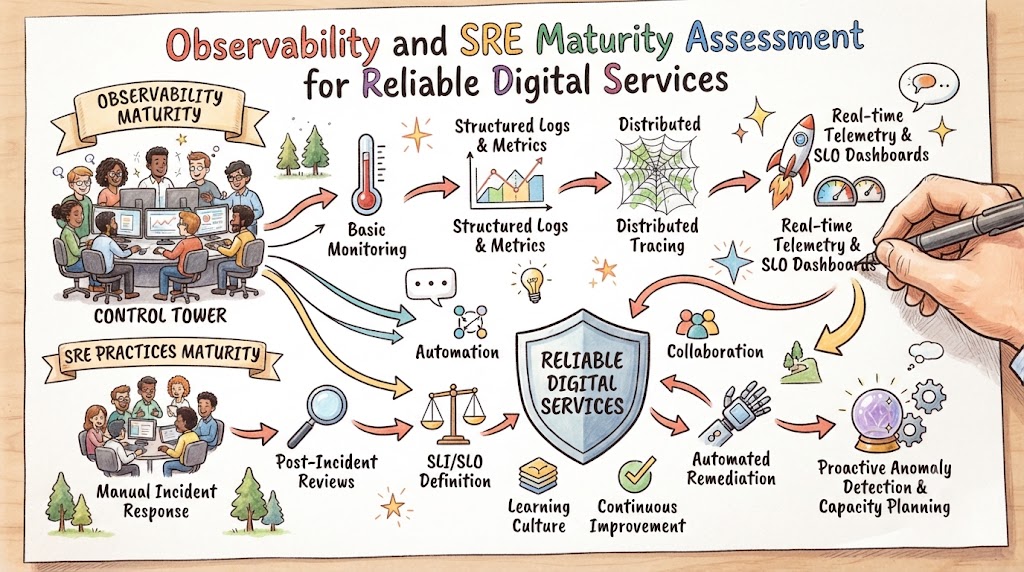
Understanding Observability and SRE Maturity Levels
Operational maturity evolves as organizations improve visibility, automation, governance, and engineering collaboration.
| Maturity Level | Characteristics |
|---|---|
| Initial | Reactive monitoring and manual operations |
| Managed | Basic observability and incident processes |
| Defined | Standardized operational practices |
| Automated | Extensive automation and reliability engineering |
| Optimized | Continuous improvement driven by operational metrics |
Organizations often mature at different rates across observability, automation, incident response, and governance, making regular assessments valuable.
Benefits of an Observability and SRE Maturity Assessment
A structured assessment delivers measurable improvements in operational performance and customer experience.
Major benefits include:
- Improved service reliability
- Faster incident detection
- Reduced Mean Time to Recovery
- Better operational visibility
- Increased automation
- Enhanced customer satisfaction
- Stronger engineering collaboration
- Reduced operational costs
- Better capacity planning
- Improved system performance
- Continuous operational improvement
- Greater business resilience
These benefits help organizations deliver reliable digital services while supporting long-term operational excellence.
Who Should Participate in the Assessment?
Observability and SRE maturity assessments benefit from broad engineering participation.
Recommended participants include:
- Chief Technology Officers
- Engineering Directors
- Site Reliability Engineers
- Platform Engineering Teams
- DevOps Engineers
- Software Architects
- Infrastructure Engineers
- Operations Teams
- Security Engineers
- Application Support Teams
- Product Managers
- Engineering Managers
Cross-functional collaboration provides a comprehensive view of operational maturity while supporting organization-wide improvements.
Best Practices for Improving Observability and SRE Maturity
Organizations should continuously evolve operational practices rather than treating reliability as a one-time initiative.
Recommended best practices include:
- Instrument applications consistently.
- Standardize telemetry collection.
- Define meaningful Service Level Objectives.
- Automate repetitive operational tasks.
- Continuously improve incident response.
- Conduct regular post-incident reviews.
- Strengthen monitoring and alert quality.
- Improve capacity planning.
- Measure operational performance continuously.
- Foster collaboration across development, operations, platform engineering, and security teams.
Following these practices helps organizations build resilient digital services capable of supporting growing business demands.
Frequently Asked Questions About Observability and SRE Maturity Assessment
1. What is an Observability and SRE Maturity Assessment?
An Observability and SRE Maturity Assessment evaluates how effectively an organization monitors, operates, automates, and continuously improves digital services. It identifies strengths, highlights operational gaps, and provides a roadmap for improving reliability and operational excellence.
2. Why are observability and SRE important for digital services?
Observability provides deep operational visibility into complex systems, while SRE introduces engineering practices that improve reliability through automation, measurable objectives, incident management, and continuous improvement. Together they help organizations deliver reliable digital services with greater confidence.
3. Does observability replace traditional monitoring?
No. Observability extends traditional monitoring by combining metrics, logs, traces, and telemetry to help engineering teams understand why issues occur rather than simply detecting that they exist. Both approaches complement one another.
4. How often should organizations perform an Observability and SRE maturity assessment?
Organizations should perform assessments periodically or following significant architectural, operational, or organizational changes. Regular evaluations help measure improvement progress and identify new opportunities for strengthening reliability.
5. What outcomes can organizations expect after completing the assessment?
Organizations typically gain improved operational visibility, stronger automation, better incident response, enhanced reliability engineering, reduced operational risks, faster issue resolution, improved customer experience, and a prioritized roadmap for continuous operational improvement.
Final Thoughts
Reliable digital services depend on much more than infrastructure availability or application monitoring. Sustainable operational excellence requires comprehensive observability, disciplined Site Reliability Engineering practices, automation, governance, measurable reliability objectives, and continuous learning. An Observability and SRE Maturity Assessment provides organizations with the structured insight needed to evaluate these capabilities objectively and identify practical improvements that strengthen service reliability.
By investing in observability, automating operational workflows, defining meaningful service level objectives, improving incident response, strengthening governance, and fostering collaboration across engineering teams, organizations can build resilient digital platforms that consistently deliver exceptional customer experiences while supporting long-term business growth.

