
Introduction
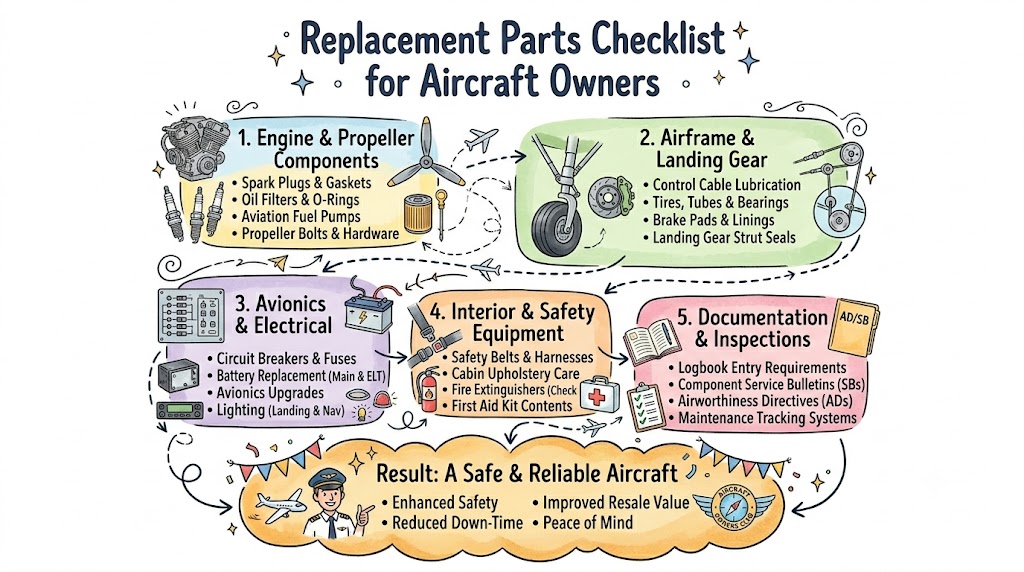
Aircraft maintenance is one of the most critical responsibilities for any aircraft owner, operator, or maintenance team. Every component in an aircraft—whether structural, mechanical, or electronic—plays a direct role in flight safety, performance, and reliability. When parts begin to wear out or require replacement, selecting the right components becomes essential.
A structured replacement parts checklist helps aircraft owners ensure that every part being installed meets safety standards, matches aircraft specifications, and comes with proper documentation. Without a proper checklist, there is a higher risk of using incompatible, low-quality, or uncertified parts, which can lead to operational failures or compliance issues.
This guide provides a detailed checklist to help aircraft owners make informed decisions when selecting and replacing aircraft components, ensuring long-term safety and airworthiness.
Real-world Use Cases
A private aircraft owner replacing worn brake components must ensure the new parts meet proper specifications to maintain safe landing performance. A maintenance technician inspecting engine replacement parts checks for material integrity and certification before installation.
A fleet operator managing multiple aircraft must maintain consistent replacement schedules to avoid unexpected downtime. A flying club coordinating shared aircraft usage needs standardized parts to ensure uniform safety across the fleet.
A pilot detecting early landing gear wear must report it for immediate replacement to prevent landing risks. A builder upgrading avionics systems must verify compatibility with existing aircraft systems. A maintenance shop verifying part authenticity ensures no counterfeit or unapproved components enter service.
Evaluation Criteria for Aircraft Replacement Parts Selection
Before selecting replacement parts, aircraft owners should evaluate:
- Compatibility with aircraft model and configuration
- Certification and documentation availability
- Manufacturer reputation and traceability
- Material quality and durability standards
- OEM vs aftermarket reliability
- Supplier authenticity and trust level
- Storage and handling condition of parts
- Inspection and quality assurance records
- Maintenance logbook update requirements
- Cost vs safety trade-offs
- Regulatory compliance requirements
- Installation support and technical guidance
A proper evaluation reduces risk and improves aircraft reliability.
Structural Components (Airframe, Frames, Brackets)
Structural parts support the overall integrity of the aircraft. Any replacement must meet strict strength and material standards.
For example, replacing a damaged bracket with a non-certified part can compromise structural stability under flight stress.
Engine Components (Pistons, Valves, Spark Plugs)
Engine parts directly affect performance, reliability, and safety. They must withstand high temperatures and pressure conditions.
For example, using low-quality spark plugs can cause engine misfires or performance loss during flight.
Avionics Systems (GPS, Radios, Sensors)
Avionics ensure safe navigation and communication. Replacement parts must be compatible and properly calibrated.
For example, an incompatible GPS unit may provide inaccurate navigation data during cross-country flights.
Landing Gear Components
Landing gear must absorb landing impact safely. Even minor defects can lead to serious risks.
For example, worn shock absorbers may cause instability during landing.
Brake System Parts
Brake components are essential for safe runway operations and stopping distance control.
For example, using worn or low-quality brake pads can increase landing roll distance.
Hydraulic System Components
Hydraulic systems control landing gear, flaps, and brakes. Any leak or failure can affect multiple systems.
For example, a hydraulic hose failure can result in landing gear malfunction.
Fuel System Parts and Filters
Fuel system integrity is critical for engine performance and safety.
For example, a clogged fuel filter can restrict fuel flow and reduce engine power.
Electrical System Components
Electrical systems power avionics, lighting, and engine support systems.
For example, a faulty alternator may lead to avionics shutdown mid-flight.
Control Surfaces and Cables
Control systems ensure maneuverability and aircraft responsiveness.
For example, worn control cables may result in delayed or uneven aircraft response.
Fasteners, Bolts, and Hardware
Even small hardware plays a major role in aircraft safety.
For example, using incorrect-grade bolts in critical areas can lead to structural failure.
Tires and Wheel Assemblies
Tires and wheels must handle landing stress and ground movement.
For example, worn tires increase risk of runway instability during landing.
Oil and Lubrication System Parts
Proper lubrication ensures engine health and reduces wear.
For example, a faulty oil pump can lead to engine overheating.
Cabin and Interior Safety Components
Interior parts may also affect safety systems like seat belts and emergency equipment.
For example, damaged seat restraints can compromise passenger safety.
Corrosion Protection Materials
Corrosion-resistant materials extend aircraft lifespan and structural integrity.
For example, untreated metal components may degrade in humid environments.
Airframe Compatibility Checks
Every replacement part must match aircraft design specifications.
For example, installing a part not designed for the airframe may cause fitting or performance issues.
OEM vs Aftermarket Part Validation
OEM parts ensure manufacturer-standard quality, while aftermarket parts vary in reliability.
For example, a certified OEM engine part is generally more predictable than an unverified aftermarket alternative.
Certification and Traceability Requirements
Proper documentation ensures parts are approved for use and can be traced back to manufacturing.
For example, missing traceability records may delay aircraft inspection approval.
Storage and Handling Conditions
Improper storage can damage replacement parts before installation.
For example, rubber components exposed to heat may degrade before use.
Inspection Requirements Before Replacement
All parts should be inspected before installation to confirm quality and condition.
For example, a visual inspection may reveal cracks or manufacturing defects.
Maintenance Logbook Documentation
Every replacement must be recorded in maintenance logs for compliance and tracking.
For example, replacing a brake system component must be documented for future reference.
Benefits of Using a Replacement Parts Checklist
A structured checklist helps aircraft owners:
- Improve safety and reliability
- Reduce unexpected failures
- Ensure compliance with regulations
- Improve maintenance planning
- Extend aircraft lifespan
- Reduce downtime
- Improve performance consistency
- Strengthen inspection readiness
- Increase aircraft resale value
OEM vs Aftermarket Aircraft Parts
| Factor | OEM Parts | Aftermarket Parts |
|---|---|---|
| Safety | High assurance | Varies |
| Reliability | Consistent | Depends on manufacturer |
| Cost | Higher | Lower |
| Documentation | Complete | May vary |
| Compatibility | Exact match | May differ |
Certified vs Non-Certified Components
| Factor | Certified Parts | Non-Certified Parts |
| Compliance | Fully compliant | Uncertain |
| Risk Level | Low | Higher |
| Traceability | Strong | Weak |
| Safety | High | Variable |
| Inspection Approval | Easier | Difficult |
New vs Overhauled Parts
| Factor | New Parts | Overhauled Parts |
| Condition | Brand new | Restored |
| Cost | Higher | Lower |
| Lifespan | Longer | Varies |
| Performance | Predictable | Depends on rebuild quality |
Trusted vs Unknown Suppliers
| Factor | Trusted Suppliers | Unknown Suppliers |
| Safety | High | Uncertain |
| Documentation | Complete | Often missing |
| Reliability | Consistent | Unpredictable |
| Support | Strong | Limited |
Practical Tips for Aircraft Owners
- Always verify supplier reputation
- Check part compatibility before purchase
- Demand full documentation and traceability
- Inspect parts before installation
- Avoid counterfeit or unverified components
- Maintain updated maintenance logs
- Plan replacement schedules in advance
Common Mistakes to Avoid
- Choosing parts only based on price
- Ignoring certification requirements
- Skipping inspection before installation
- Using incompatible components
- Not updating maintenance records
- Relying on unknown suppliers
FAQs
1. Why is a replacement parts checklist important?
It ensures safety, compliance, and proper selection of aircraft components during maintenance or repair.
2. How do I verify aircraft part quality?
Check certification documents, supplier reputation, and physical inspection before installation.
3. What is the difference between OEM and aftermarket parts?
OEM parts are manufacturer-approved, while aftermarket parts vary in quality depending on the producer.
4. Are low-cost parts safe for aircraft?
Low-cost parts may carry higher risks if they lack certification or proper testing.
5. Why is documentation important?
Documentation ensures traceability, compliance, and inspection readiness.
6. How often should aircraft parts be replaced?
Replacement depends on usage, wear, manufacturer guidelines, and inspection findings.
7. Can I mix different part suppliers?
Yes, but compatibility and certification must be verified carefully.
8. What is the biggest risk in part replacement?
Using uncertified or incompatible parts that affect aircraft safety.
9. How do I choose suppliers?
Select suppliers with proven reputation, proper documentation, and aviation experience.
10. Why is inspection necessary before installation?
Inspection ensures parts are defect-free and suitable for safe aircraft operation.
Conclusion
A structured replacement parts checklist is essential for aircraft owners to ensure safety, reliability, and compliance during maintenance activities. Every component installed in an aircraft plays a critical role in performance and structural integrity, making careful selection and verification extremely important. By using trusted suppliers, verifying documentation, and following proper inspection procedures, aircraft owners can reduce risks and improve operational efficiency. A disciplined approach to replacement parts not only enhances safety but also supports long-term aircraft performance, reduced downtime, and improved maintenance planning.

