
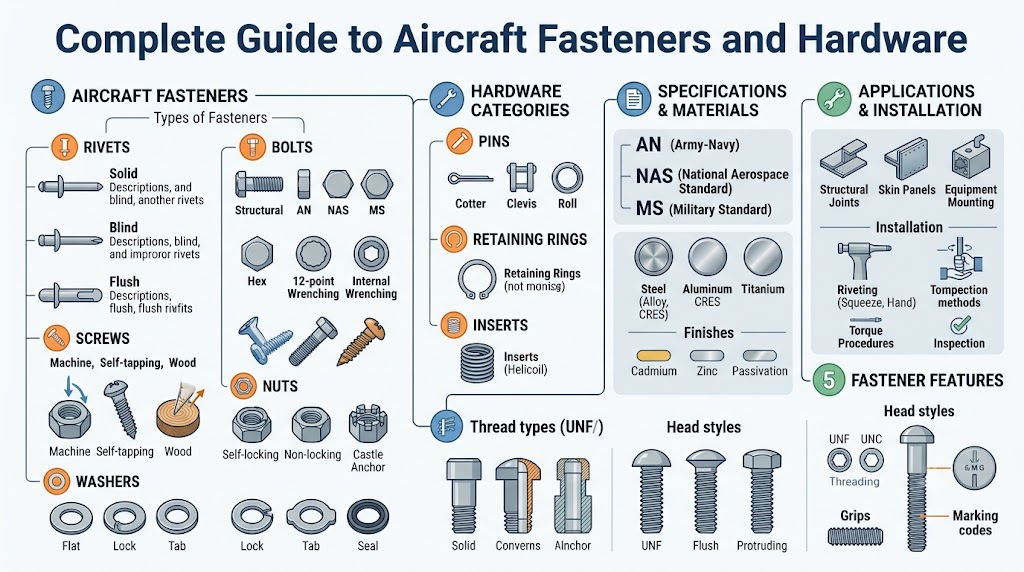
Aircraft fasteners and hardware may be small compared with major aircraft components, but they play an essential role in keeping assemblies properly secured. Bolts, nuts, screws, washers, rivets, pins, retaining components, and specialty hardware can be found throughout aircraft structures and systems.
Choosing the correct hardware is not simply a matter of finding a part that looks similar to the original. Material, specification, dimensions, thread characteristics, finish, application, and approved documentation can all matter.
What Are Aircraft Fasteners?
Aircraft fasteners are components used to join, secure, retain, or attach aircraft parts and assemblies.
Depending on the application, fasteners can help:
- Join components
- Secure removable panels
- Attach brackets
- Retain mechanical components
- Connect assemblies
- Secure approved structural components
- Support serviceable aircraft systems
Aircraft fasteners are designed and selected according to the requirements of their intended application.
A fastener that appears physically similar to another part may still have different material, strength, thread, finish, or specification characteristics.
That is why visual similarity should never be treated as proof of compatibility.
What Is Aircraft Hardware?
Aircraft hardware is a broader category that includes many of the small components used to assemble, secure, retain, and maintain aircraft parts.
Common categories include:
- Bolts
- Screws
- Nuts
- Washers
- Rivets
- Pins
- Retaining rings
- Specialty fasteners
- Locking hardware
- Other application-specific components
The exact terminology and classification can vary depending on the aircraft, manufacturer, component, and applicable documentation.
Why Aircraft Fasteners and Hardware Matter
Aircraft hardware performs important mechanical functions throughout an aircraft.
Correct hardware selection can contribute to:
- Mechanical security
- Proper component retention
- Structural integrity
- Vibration resistance
- Corrosion resistance
- Serviceability
- Assembly reliability
- Long-term durability
The importance of a fastener depends heavily on where and how it is used.
A small component may be used in an application where its material, dimensions, locking characteristics, or corrosion resistance are critical.
For this reason, aircraft hardware should be treated as a specified aircraft component, not as an interchangeable commodity.
Major Types of Aircraft Fasteners
1. Aircraft Bolts
Aircraft bolts are commonly used where components need to be securely joined using a bolted connection.
Depending on the application, aircraft bolts may differ in:
- Head design
- Material
- Finish
- Thread characteristics
- Length
- Shank characteristics
- Manufacturer or specification
A bolt should be selected according to the applicable aircraft documentation and required specification.
Using a bolt simply because it has a similar size or appearance can create compatibility problems.
2. Aircraft Screws
Aircraft screws are used in many applications, including securing panels, covers, brackets, and other components where an appropriate screw is specified.
Screws can differ in:
- Head style
- Drive type
- Material
- Finish
- Thread
- Length
- Intended application
Common screw designs may include different head configurations depending on the assembly.
An ordinary commercial screw should not automatically be considered an acceptable substitute for an aircraft screw.
3. Aircraft Nuts
Nuts provide the mating threaded component for many aircraft bolts and other threaded fasteners.
Common categories can include:
- Standard nuts
- Locking nuts
- Castellated nuts
- Specialized application-specific nuts
Locking nuts are designed to help resist unintended loosening where their use is approved.
Castellated nuts may be used with appropriate retaining hardware in applications where that configuration is specified.
The correct nut depends on the aircraft application and applicable documentation.
4. Aircraft Washers
Washers may be used for several purposes, including:
- Load distribution
- Surface protection
- Spacing
- Assembly requirements
- Supporting specified fastening arrangements
Different washer designs may be intended for different applications.
Examples can include:
- Flat washers
- Locking washers where approved
- Special-purpose washers
A washer should not be selected simply because it fits over a bolt.
Its material, dimensions, function, and approved application can all matter.
5. Aircraft Rivets
Rivets are widely associated with aircraft construction and repair.
Common categories include:
- Solid rivets
- Blind rivets
- Specialty rivets
Different rivets can have very different applications.
Some rivets may be intended for particular structural applications, while others may be designed for specific non-structural or access-related uses.
Rivet selection and installation are highly application-specific. Aircraft plans and approved maintenance documentation should determine what type of rivet is appropriate.
This guide does not provide step-by-step riveting procedures because incorrect rivet selection or installation can affect aircraft integrity.
6. Aircraft Pins
Pins can be used to retain or position components in different aircraft assemblies.
Examples may include:
- Cotter pins
- Clevis pins
- Retaining pins
- Spring-type pins where specified
- Other specialized pins
Each type has a specific purpose and should be selected according to the applicable application.
A pin that physically fits an opening is not automatically an acceptable replacement.
7. Retaining Rings and Related Hardware
Retaining rings and similar components are designed to hold components in their intended positions.
They can be used in mechanical assemblies where axial retention is required.
Important considerations include:
- Correct ring type
- Correct size
- Material
- Groove compatibility
- Application
- Manufacturer requirements
Incorrect retaining hardware can result in improper component retention.
Aircraft Hardware Materials
Aircraft hardware may be manufactured from different materials depending on the application.
Steel
Steel hardware can provide useful mechanical properties for many applications.
Different steel compositions and treatments can have different characteristics, so the exact material specification matters.
Stainless Steel
Stainless steel is commonly associated with applications where corrosion resistance is important.
However, stainless steel is not automatically a substitute for another material.
The application must determine whether it is appropriate.
Aluminum
Aluminum hardware can be useful where weight and material compatibility are important considerations.
Its characteristics differ from steel and other materials.
Titanium
Titanium can be used in specialized aerospace applications where its combination of properties makes it suitable.
Because different titanium hardware products can have different specifications, identification and documentation remain important.
Aircraft Hardware Finishes and Corrosion Protection
The surface finish of aircraft hardware can affect its resistance to environmental conditions and its compatibility with surrounding materials.
Depending on the product, finishes or treatments may be used to improve:
- Corrosion resistance
- Surface durability
- Environmental resistance
- Material compatibility
Changing a specified finish without proper approval can create unexpected problems.
This is particularly important when aircraft hardware is exposed to:
- Moisture
- Salt
- Humidity
- Chemicals
- Temperature changes
- Dissimilar metals
Understanding Galvanic Corrosion
Galvanic corrosion can occur when dissimilar metals are placed in contact under conditions that allow an electrochemical reaction.
In aircraft applications, material compatibility is therefore important.
For example, simply selecting a different metal because it is readily available can change the corrosion behavior of an assembly.
Aircraft documentation and qualified maintenance personnel should determine acceptable material combinations for specific applications.
Aircraft Fastener Identification
Correct identification is one of the most important parts of aircraft hardware selection.
A fastener may be identified using information such as:
- Part number
- Manufacturer marking
- Head marking
- Specification
- Material designation
- Size
- Length
- Thread characteristics
- Finish
- Packaging information
Some aircraft hardware may have markings that provide useful identification information.
However, markings should be interpreted correctly rather than guessed.
When the identity of a component is uncertain, the safest approach is to verify it using applicable documentation or qualified aviation personnel.
Understanding Aircraft Fastener Threads
Threads are a fundamental part of many aircraft fastening systems.
Important terminology includes:
- Thread size
- Thread pitch
- Threaded length
- Thread engagement
- Thread type
- Internal thread
- External thread
Two fasteners may appear almost identical while having different thread characteristics.
Using the wrong thread can lead to:
- Poor engagement
- Improper assembly
- Component damage
- Reduced reliability
- Compatibility problems
A threaded component should therefore be identified by its correct specification rather than by appearance alone.
Locking Methods and Retention Hardware
Aircraft assemblies may use different methods to prevent unintended loosening.
Examples include:
- Locking nuts
- Castellated nuts
- Appropriate retaining pins
- Approved locking devices
- Other specified retention methods
The correct method depends on the application.
A locking method that is suitable for one assembly may not be appropriate for another.
For this reason, aircraft documentation should determine the required hardware and retention arrangement.
Structural vs. Non-Structural Hardware
Not every aircraft fastener has the same level of application significance.
| Factor | Structural Application | Non-Structural / Application-Specific |
|---|---|---|
| Primary purpose | Supports or secures an engineered assembly | Secures or retains components for a specific purpose |
| Hardware requirements | Highly application-dependent | Application-dependent |
| Documentation importance | Critical | Important |
| Load considerations | May be significant | Depends on application |
| Material considerations | Important | Important |
| Substitution risk | Potentially significant | Can still be significant |
| Inspection considerations | Depends on approved requirements | Depends on application |
The distinction does not mean that non-structural hardware is unimportant.
Incorrect hardware can cause problems in either type of application.
How to Select the Correct Aircraft Fastener
Selecting aircraft hardware should begin with identification rather than guesswork.
Step 1: Identify the Aircraft and Component
Determine exactly where the hardware is intended to be used.
Step 2: Review Approved Documentation
Use the applicable aircraft plans, maintenance documentation, parts information, or other approved sources.
Step 3: Confirm the Required Part or Specification
Identify the exact part number or specification when available.
Step 4: Verify the Material
Confirm that the material matches the specified requirement.
Step 5: Verify Dimensions
Check the required dimensions rather than relying on visual similarity.
Step 6: Verify Thread Characteristics
Where applicable, confirm the correct thread type and characteristics.
Step 7: Check the Finish
Make sure the surface finish or treatment matches the application.
Step 8: Confirm Compatibility
Consider the surrounding materials and assembly requirements.
Step 9: Check Condition
Inspect the hardware for obvious damage, corrosion, contamination, or deterioration.
Step 10: Confirm Traceability
Where required, retain relevant identification and documentation.
Aircraft Fastener Inspection Considerations
Inspection requirements vary by aircraft and application, but hardware may be evaluated for conditions such as:
- Corrosion
- Damaged threads
- Deformation
- Surface damage
- Deterioration
- Missing components
- Incorrect hardware
- Evidence of loosening
- Contamination
Inspection should be performed according to the applicable aircraft maintenance documentation.
Aircraft owners and pilots should not assume that an apparently minor hardware problem can be safely evaluated or corrected without qualified maintenance expertise.
Aircraft Hardware and Corrosion
Corrosion is one of the important concerns associated with aircraft hardware.
Potential contributing factors include:
- Moisture
- Humidity
- Salt exposure
- Damaged protective finishes
- Dissimilar metals
- Improper storage
- Contaminants
Corrosion can affect both the appearance and functional condition of hardware.
If corrosion or deterioration is suspected, the appropriate maintenance documentation and qualified personnel should determine the required evaluation or corrective action.
Aircraft Fastener Storage and Handling
Proper storage helps protect aircraft hardware before it is needed.
Good general practices include:
- Keep hardware clean and dry
- Protect parts from contamination
- Keep original identification with the hardware
- Separate different part numbers
- Protect packaging
- Avoid unnecessary handling
- Prevent moisture exposure
- Maintain inventory records
- Store hardware according to applicable manufacturer requirements
Mixed containers containing visually similar fasteners can create unnecessary identification risks.
A well-organized inventory makes it easier to locate the correct component.
Aircraft Hardware Quality and Traceability
For aircraft parts, knowing where a component came from can be important.
Depending on the application, buyers may need to consider:
- Manufacturer
- Part number
- Applicable specification
- Documentation
- Traceability
- Packaging
- Condition
- Source reliability
Traceability requirements can vary according to the aircraft, component, maintenance activity, and applicable rules.
Buyers should avoid assuming that an unmarked or poorly documented fastener is acceptable simply because its dimensions appear correct.
OEM, Approved, and Replacement Hardware
Aircraft hardware may be encountered through different sourcing channels.
These can include:
- Original equipment hardware
- Approved replacement hardware
- Specification-compliant hardware
- Other replacement components
The important question is not simply whether a replacement looks similar.
The replacement must be appropriate for the aircraft application and supported by the relevant documentation or specification.
Commercial availability does not automatically establish aircraft suitability.
Common Aircraft Fastener and Hardware Mistakes
1. Choosing Hardware by Appearance
Two fasteners can look almost identical while having different specifications.
Better approach: Confirm the part number or applicable specification.
2. Using the Wrong Material
Different materials have different properties and compatibility considerations.
Better approach: Verify the specified material before purchase or use.
3. Ignoring Thread Differences
A threaded component may appear to fit while having incorrect thread characteristics.
Better approach: Confirm the correct thread specification.
4. Mixing Incompatible Hardware
Using different materials or hardware types without verifying compatibility can create problems.
Better approach: Follow the applicable aircraft documentation.
5. Using Damaged Hardware
Damaged threads, corrosion, deformation, or other deterioration can affect hardware suitability.
Better approach: Have questionable hardware evaluated according to appropriate maintenance requirements.
6. Ignoring Corrosion
Small signs of corrosion should not automatically be dismissed.
Better approach: Follow the aircraft’s applicable inspection and maintenance requirements.
7. Losing Part-Number Information
Once hardware becomes separated from its packaging, identification can become difficult.
Better approach: Keep hardware properly labeled and organized.
8. Buying From Uncertain Sources
Low price alone does not establish quality, suitability, or traceability.
Better approach: Consider supplier reliability, product identification, documentation, and traceability.
9. Assuming Ordinary Hardware Is Aircraft-Approved
Commercial hardware may look similar to aviation hardware.
Better approach: Verify the required specification before use.
10. Ignoring Manufacturer Documentation
Generic hardware knowledge cannot replace aircraft-specific documentation.
Better approach: Use the applicable aircraft plans, parts information, and maintenance documentation.
11. Reusing Hardware Without Verification
Whether a component can be reused depends on the specific hardware, application, and applicable requirements.
Better approach: Follow the relevant maintenance documentation and qualified guidance.
12. Selecting Hardware Solely on Price
The cheapest component is not necessarily the correct component.
Better approach: Consider specification, quality, traceability, compatibility, and application.
Buying Aircraft Fasteners and Hardware
Purchasing aircraft hardware requires more than searching for a similar-looking component.
Product Identification
Start with the exact part number or specification whenever available.
Compatibility
Confirm that the hardware is appropriate for the intended aircraft application.
Material
Verify the required material.
Finish
Check whether the required surface treatment or finish is specified.
Condition
Understand whether the component is new, serviceable, or otherwise categorized.
Documentation
Determine what documentation or traceability information is appropriate for the application.
Supplier Reliability
Consider the supplier’s product information, packaging, identification, and traceability practices.
Quantity
Avoid purchasing random mixed hardware when exact identification is required.
Storage
Have an appropriate storage and labeling system ready before building an inventory.
How to Build an Aircraft Hardware Inventory
A well-organized inventory can reduce the possibility of selecting the wrong part.
Consider organizing hardware by:
- Part number
- Hardware type
- Material
- Size
- Thread type
- Application
- Quantity
- Condition
- Packaging
- Traceability
- Storage location
Use clear labeling and keep similar-looking hardware separated when their specifications differ.
For maintenance organizations, inventory controls can also help track parts movement and documentation.
Aircraft Fasteners for Aircraft Builders
Aircraft builders often work with a wide range of small hardware components.
A good hardware-management approach includes:
- Understanding the aircraft plans
- Using specified hardware
- Organizing parts before construction
- Maintaining identification
- Keeping different hardware categories separated
- Protecting components from contamination
- Maintaining relevant documentation
- Avoiding substitutions without appropriate verification
Builders should never assume that an alternative fastener is acceptable simply because it fits physically.
Where the aircraft design specifies particular hardware, that specification should be followed.
Aircraft Fasteners for Aircraft Owners and Maintenance Teams
Aircraft owners do not necessarily need to become hardware experts, but understanding basic hardware concepts can help them communicate effectively with maintenance professionals.
Owners can pay attention to:
- Correct part identification
- Obvious corrosion
- Missing hardware
- Damaged components
- Maintenance documentation
- Part-number information
- Supplier documentation
However, recognizing a potential problem is different from performing maintenance.
When hardware condition, replacement, or installation is uncertain, qualified aviation maintenance personnel should evaluate the situation according to applicable documentation.
Aircraft Hardware Comparison Table
| Hardware Type | General Purpose | Common Considerations | Typical Application |
|---|---|---|---|
| Bolts | Joining and securing components | Material, dimensions, threads, application | Various aircraft assemblies |
| Screws | Securing components | Head, thread, material, application | Panels and specified assemblies |
| Nuts | Mating with threaded fasteners | Locking method, material, compatibility | Bolted assemblies |
| Washers | Load distribution, spacing, protection | Size, material, function | Fastener assemblies |
| Rivets | Permanent fastening | Type, material, application | Aircraft structures and specified assemblies |
| Pins | Retention or positioning | Type, size, application | Mechanical assemblies |
| Retaining Rings | Component retention | Ring type, size, groove compatibility | Mechanical assemblies |
| Specialty Hardware | Specific engineered functions | Exact specification and application | Specialized aircraft assemblies |
Aircraft Hardware Selection Checklist
Identification
- Aircraft or component identified
- Correct part number confirmed
- Applicable specification verified
- Manufacturer documentation reviewed
Compatibility
- Material confirmed
- Dimensions confirmed
- Thread characteristics confirmed where applicable
- Finish confirmed
- Application confirmed
- Compatibility reviewed
Condition
- Hardware inspected
- Corrosion checked
- Threads checked
- Damage checked
- Packaging reviewed
Documentation
- Traceability reviewed where applicable
- Supplier information recorded
- Supporting documentation retained where required
Storage
- Hardware properly labeled
- Parts protected from contamination
- Different hardware types separated
- Inventory updated
Decision Guide for Choosing Aircraft Hardware
If You Know the Part Number
Verify the part number against the applicable aircraft documentation before purchasing.
If You Only Know the Appearance
Do not assume that appearance confirms compatibility. Obtain proper identification.
If the Original Hardware Is Damaged
Identify the appropriate replacement rather than selecting a visually similar component.
If the Hardware Is Corroded
Have the condition evaluated according to the appropriate maintenance requirements.
If You Are Unsure About Material or Threads
Stop and verify the specification before proceeding.
If You Are Building an Aircraft
Follow the aircraft plans, applicable documentation, and relevant requirements.
If You Are Performing Maintenance
Use qualified maintenance personnel and applicable approved maintenance information.
Frequently Asked Questions
Q1. What are aircraft fasteners?
Aircraft fasteners are components used to join, secure, retain, or attach aircraft parts and assemblies.
Q2. What is the difference between aircraft fasteners and general hardware?
Aircraft fasteners and hardware are selected for specific aviation applications and specifications. General commercial hardware should not automatically be treated as an aircraft-approved substitute.
Q3. What are the most common types of aircraft fasteners?
Common categories include bolts, screws, nuts, washers, rivets, pins, retaining rings, and specialized fasteners.
Q4. Why are aircraft fasteners available in different materials?
Different materials provide different combinations of mechanical properties, weight, corrosion resistance, and compatibility.
Q5. How can aircraft fasteners be identified?
Identification can involve part numbers, markings, specifications, dimensions, material information, finish, packaging, and applicable documentation.
Q6. What is the difference between an aircraft bolt and an aircraft screw?
Bolts and screws are different categories of threaded fasteners with differences in design and application. The exact distinction depends on the hardware specification and intended assembly.
Q7. Why are locking nuts and retaining hardware used?
They can help prevent unintended movement or loosening when specified for a particular application.
Q8. Can ordinary hardware be used on an aircraft?
Not automatically. Aircraft documentation and applicable specifications should determine whether a particular hardware component is suitable.
Q9. How should aircraft fasteners be stored?
They should generally be protected from moisture, contamination, damage, and loss of identification, while following applicable storage requirements.
Q10. How can buyers verify aircraft hardware compatibility?
Buyers should confirm the part number or specification, material, dimensions, thread characteristics, finish, application, and relevant documentation.
Q11. What should I do if I cannot identify an aircraft fastener?
Do not guess based on appearance. Use applicable aircraft documentation or seek assistance from qualified aviation maintenance personnel.
Q12. Why is aircraft hardware traceability important?
Traceability can help establish the identity and history of a component where such documentation is required or appropriate.
Q13. What are common aircraft fastener mistakes?
Common mistakes include using visually similar hardware, ignoring material or thread differences, overlooking corrosion, losing identification information, and making unverified substitutions.
Q14. When should aircraft hardware selection be handled by qualified maintenance personnel?
Qualified personnel should be involved whenever hardware selection, condition, replacement, installation, or application has implications for aircraft maintenance or airworthiness and the applicable requirements are not clear to the owner or builder.
Conclusion
Aircraft fasteners and hardware are small components with important roles throughout an aircraft.
Correct identification requires more than matching appearance, size, or availability.
Material, specification, thread characteristics, finish, compatibility, condition, and documentation can all matter.
Aircraft owners and builders should maintain organized hardware inventories and avoid unverified substitutions.
When hardware selection or condition is uncertain, the applicable aircraft documentation and qualified maintenance personnel should guide the decision.
Choosing the right hardware is ultimately about accuracy, compatibility, traceability, and responsible aircraft maintenance.

