
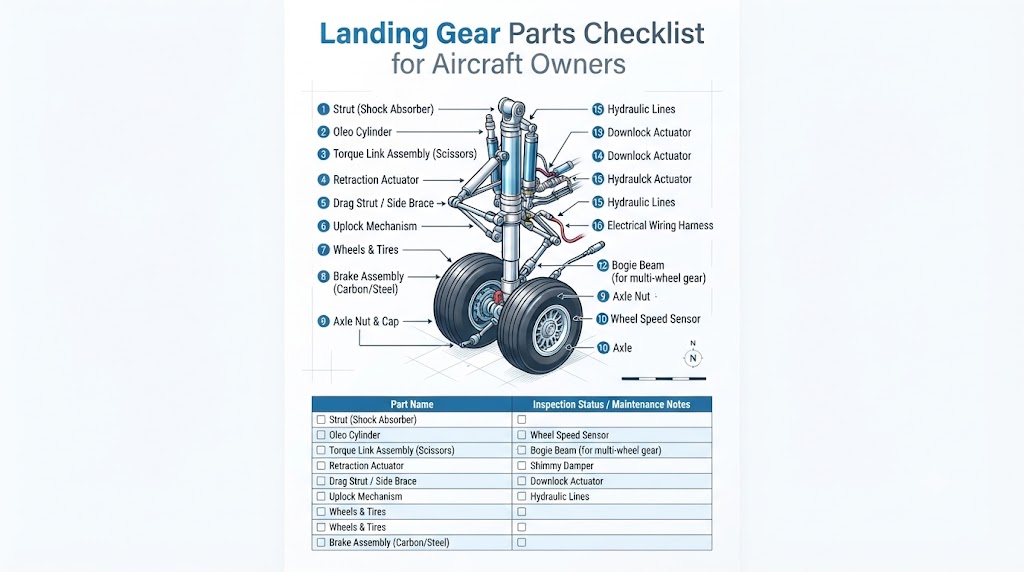
Landing gear is one of the most important aircraft systems for safe ground movement, takeoff, and landing. For aircraft owners, understanding the major landing gear parts can make maintenance planning, recordkeeping, and replacement-part research much easier.
A structured checklist can also help owners communicate more effectively with qualified aviation maintenance professionals. Since landing gear configurations differ between aircraft, owners should always rely on the aircraft manufacturer’s documentation and applicable maintenance requirements for aircraft-specific decisions.
Why Should Aircraft Owners Understand Landing Gear Parts?
Aircraft owners do not necessarily need to perform their own landing gear maintenance, but understanding the system can help them stay organized and recognize when professional attention may be appropriate.
A landing gear system can influence:
- Ground handling
- Taxiing
- Braking
- Takeoff
- Landing
- Aircraft stability
- Steering
- Shock absorption
- Aircraft storage and maintenance planning
Different aircraft use different landing gear designs, so the exact components can vary considerably.
What Are the Main Aircraft Landing Gear Components?
Depending on the aircraft, a landing gear system may include:
- Main landing gear
- Nose gear or tailwheel
- Wheels
- Tires
- Brakes
- Axles
- Bearings
- Struts
- Springs
- Dampers
- Steering components
- Retaining hardware
- Hydraulic components
- Electrical components
- Retracting mechanisms
- Gear doors
Not every aircraft uses all of these components.
The first step for an owner is therefore to understand the specific landing gear configuration installed on their aircraft.
1. Main Landing Gear
The main landing gear supports much of the aircraft’s weight during ground operations.
Depending on the design, owners may encounter:
- Main gear legs
- Wheels
- Tires
- Brake assemblies
- Axles
- Bearings
- Struts
- Supporting hardware
- Attachment components
During maintenance planning, these components should be reviewed according to the aircraft’s applicable maintenance documentation.
Owners should also keep track of repairs, replacements, and inspections involving the main gear.
2. Nose Landing Gear
Aircraft equipped with a nosewheel configuration have additional components that require attention.
Common components can include:
- Nose gear structure
- Nose wheel
- Tire
- Steering mechanism
- Strut or shock-absorbing components
- Bearings
- Axle
- Supporting hardware
Nose gear can have a significant effect on ground steering and handling.
Because nose gear designs differ between aircraft, owners should avoid assuming that a procedure or replacement component from another aircraft is suitable for their own aircraft.
3. Tailwheel Components
Tailwheel aircraft have a different landing gear arrangement.
Common tailwheel components can include:
- Tailwheel
- Tire
- Fork or support assembly
- Steering components
- Bearings
- Axle
- Mounting hardware
Owners of tailwheel aircraft should become familiar with the aircraft’s specific tailwheel configuration and applicable maintenance requirements.
4. Aircraft Wheels
Aircraft wheels provide the mounting structure for tires and may be integrated with braking systems depending on the aircraft design.
When reviewing wheels, owners may need to consider:
- General condition
- Visible damage
- Corrosion
- Bearing condition
- Hardware
- Brake-related components
- Maintenance history
Wheel maintenance should follow aircraft-specific documentation and qualified maintenance guidance.
5. Aircraft Tires
Tires are among the most visible landing gear components, making them relatively easy for owners to monitor.
Owners can remain alert for issues such as:
- Uneven wear
- Visible damage
- Cracking
- Abnormal wear patterns
- Foreign-object damage
- Other unusual conditions
However, visual observation alone does not establish whether a tire is suitable for continued operation.
When a concern appears, owners should seek appropriate professional evaluation.
6. Aircraft Brakes
Braking systems are an important part of ground operations.
Depending on the aircraft, brake systems may include:
- Brake assemblies
- Brake discs or drums
- Brake lines
- Hoses
- Master cylinders
- Fluid reservoirs
- Supporting hardware
Brake configurations differ significantly between aircraft.
Owners should maintain records of relevant brake maintenance and avoid assuming that a particular brake component or fluid is suitable without verifying the aircraft-specific requirements.
7. Landing Gear Struts
Struts and other shock-absorbing components help manage loads during aircraft ground operations.
Depending on the design, an aircraft may use:
- Shock struts
- Springs
- Dampers
- Other shock-absorbing systems
Owners should understand which system their aircraft uses and follow the applicable manufacturer’s documentation.
Any unusual condition involving a structural or shock-absorbing component should receive appropriate professional attention.
8. Bearings and Axles
Bearings and axles play an important role in wheel operation.
Owners may want to keep records relating to:
- Bearing inspections
- Bearing replacement
- Axle condition
- Related maintenance
- Relevant component identification
These are safety-critical components, so owners should not rely on generic maintenance assumptions.
The correct maintenance requirements should come from the aircraft’s approved or applicable documentation and qualified maintenance personnel.
9. Steering Components
Aircraft with nosewheel or tailwheel steering systems may have several components that connect the pilot’s control inputs to the wheel assembly.
Depending on the aircraft, these may include:
- Steering linkages
- Cables
- Push-pull components
- Control arms
- Fork assemblies
- Supporting hardware
Unusual steering behavior should not be ignored.
If an aircraft develops abnormal ground handling characteristics, owners should have the issue evaluated by an appropriately qualified aviation maintenance professional.
10. Retractable Landing Gear Components
Retractable landing gear systems can be considerably more complex than fixed gear.
Depending on the aircraft, the system may contain:
- Hydraulic components
- Electrical components
- Actuators
- Mechanical linkages
- Gear doors
- Position indicators
- Locking mechanisms
- Supporting hardware
Because these systems can affect the aircraft’s ability to safely configure for takeoff and landing, owners should follow the aircraft-specific maintenance procedures carefully.
Landing Gear Parts Checklist
A simple checklist can help aircraft owners organize their records and maintenance discussions.
Main Gear
- Main gear structure reviewed
- Wheels reviewed
- Tires reviewed
- Brake assemblies reviewed
- Axles reviewed
- Bearings reviewed
- Struts reviewed where applicable
- Attachment hardware reviewed
Nose Gear
- Nose gear structure reviewed
- Nose wheel reviewed
- Tire reviewed
- Steering components reviewed
- Bearings reviewed
- Axle reviewed
- Supporting hardware reviewed
Tailwheel
- Tailwheel reviewed where applicable
- Tire reviewed
- Fork or support assembly reviewed
- Steering system reviewed
- Bearings reviewed
- Axle reviewed
- Mounting hardware reviewed
Retractable Gear
- Actuation system reviewed
- Gear doors reviewed
- Position indication reviewed
- Locking mechanisms reviewed
- Hydraulic components reviewed where applicable
- Electrical components reviewed where applicable
How to Review Landing Gear Replacement Parts
Buying the correct aircraft part requires more than finding something that looks similar.
Before purchasing a replacement landing gear component, owners should verify:
Aircraft Model
Confirm the exact aircraft model and configuration.
Component Identification
Check the relevant part identification information provided in the aircraft’s documentation.
Part Number
Where applicable, verify the exact part number rather than relying on appearance.
Compatibility
Confirm that the component is appropriate for the specific aircraft and installation.
Condition
Determine whether the component is:
- New
- Used
- Repaired
- Overhauled
- Reconditioned
Documentation
Review any documentation supplied with the component and retain appropriate records.
Professional Review
When there is uncertainty about compatibility or installation requirements, consult a qualified aviation maintenance professional.
Why Aircraft Parts Documentation Matters
Aircraft owners should treat documentation as an important part of parts management.
Useful records can include:
- Part numbers
- Maintenance records
- Inspection records
- Replacement dates
- Repair documentation
- Modification records
- Supplier documentation
- Relevant component history
Good documentation helps owners understand what has been installed and can simplify future maintenance planning.
It may also be valuable when the aircraft is inspected, maintained, or eventually transferred to another owner.
Signs That Landing Gear May Need Professional Attention
Aircraft owners should remain aware of changes in aircraft behavior or visible component condition.
Potential warning signs can include:
- Unusual tire wear
- Visible cracks
- Corrosion
- Fluid leakage
- Unusual vibration
- Abnormal noises
- Steering changes
- Brake performance concerns
- Visible deformation
- Unusual landing gear movement
These signs do not automatically identify a specific fault.
Instead, they should prompt appropriate evaluation by a qualified maintenance professional.
Common Landing Gear Parts Buying Mistakes
1. Buying Based Only on Appearance
Two components may look similar while having different applications.
Better approach: Verify the component using aircraft-specific documentation and applicable part information.
2. Ignoring Part Numbers
Using only a general component description can lead to confusion.
Better approach: Record and verify the applicable part identification information.
3. Assuming Parts Are Interchangeable
Aircraft components are not automatically interchangeable simply because they have similar dimensions or appearance.
Better approach: Confirm compatibility before purchase.
4. Choosing Only by Price
The cheapest component may not provide the appropriate documentation, condition, or compatibility.
Better approach: Consider condition, documentation, traceability where relevant, and suitability.
5. Ignoring Component History
A used or repaired part may require additional documentation or evaluation.
Better approach: Understand the component’s condition and available history before purchasing.
6. Failing to Maintain Records
Replacing a component without properly updating records can create confusion later.
Better approach: Retain relevant documentation and ensure appropriate maintenance records are updated.
How Owners Can Prepare for a Landing Gear Inspection
Aircraft owners can make maintenance appointments more productive by preparing relevant information beforehand.
Gather Documentation
Have applicable aircraft and maintenance records available.
Note Unusual Observations
Write down any changes noticed during normal aircraft operation.
Identify Recent Work
Tell the maintenance professional about recently replaced components or repairs.
Make Relevant Areas Accessible
Follow appropriate instructions for preparing the aircraft for inspection.
Prepare Questions
Ask about:
- Component condition
- Upcoming maintenance
- Replacement planning
- Parts availability
- Documentation requirements
- Any unusual observations
This approach can help create a clearer maintenance discussion.
Landing Gear Parts Buying Checklist
Before purchasing a component, review the following:
- Confirm aircraft make and model
- Confirm aircraft configuration
- Identify the correct component
- Verify applicable part number
- Check compatibility
- Review component condition
- Determine whether the component is new, used, repaired, or overhauled
- Review available documentation
- Consider traceability where relevant
- Verify supplier information
- Consult qualified maintenance personnel when necessary
- Retain appropriate purchase and component records
Questions to Ask Before Buying Landing Gear Parts
Aircraft owners can ask suppliers and maintenance professionals:
- Is this the correct component for my aircraft?
- What documentation supports its identification?
- What is the exact part number?
- Is the component new, used, repaired, or overhauled?
- Is its condition documented?
- Is relevant traceability available?
- Are installation instructions available?
- Does the aircraft manufacturer specify particular requirements?
- Should the component be reviewed by a qualified maintenance professional before installation?
- What records should be retained after the component is installed?
Landing Gear Maintenance Record Checklist
Maintaining organized records can help owners manage their aircraft more effectively.
Keep track of:
- Landing gear inspections
- Wheel maintenance
- Tire replacements
- Brake maintenance
- Bearing work
- Axle-related work
- Strut maintenance
- Steering-system maintenance
- Retractable gear maintenance where applicable
- Component replacements
- Repairs
- Modifications
- Relevant part numbers
- Supporting documentation
Frequently Asked Questions
Q1. What are the main parts of aircraft landing gear?
Common components can include wheels, tires, brakes, axles, bearings, struts, steering components, structural assemblies, and supporting hardware. Retractable aircraft may also have hydraulic, electrical, mechanical, and locking components.
Q2. How often should landing gear be inspected?
Inspection requirements vary according to the aircraft, its configuration, operating conditions, and applicable requirements. Owners should follow the aircraft’s maintenance documentation and applicable regulations.
Q3. Can landing gear parts be interchangeable between aircraft?
Not necessarily. Components that appear similar may have different specifications or applications. Compatibility should be verified using appropriate aircraft and component documentation.
Q4. What should I check before buying a landing gear part?
Verify the aircraft model, configuration, part identification, compatibility, condition, documentation, and applicable requirements. When uncertain, consult qualified maintenance personnel.
Q5. Why are landing gear maintenance records important?
Records help establish component history, support maintenance planning, document replacements and repairs, and provide useful information for future inspections or ownership transfers.
Q6. What are common signs of landing gear problems?
Unusual tire wear, visible damage, corrosion, leakage, vibration, abnormal noises, steering changes, and brake concerns can indicate that professional evaluation may be appropriate.
Q7. Can aircraft owners inspect landing gear themselves?
Owners can monitor their aircraft and become familiar with visible components, but inspection and maintenance requirements depend on the aircraft and applicable regulations. Safety-critical maintenance should be performed or supervised as required by appropriately qualified professionals.
Q8. Are retractable landing gear systems more complex?
They can be more complex because they may incorporate additional hydraulic, electrical, mechanical, indication, and locking components. Aircraft-specific documentation is particularly important for these systems.
Final Thoughts
A well-organized landing gear parts checklist can help aircraft owners understand their aircraft, maintain better records, plan maintenance, and make more informed replacement-part decisions. The most important areas to monitor include wheels, tires, brakes, bearings, axles, struts, steering components, structural assemblies, and retractable gear components where applicable. When purchasing replacement parts, never rely solely on appearance or price. Verify the aircraft configuration, part identification, compatibility, condition, and supporting documentation before proceeding. Most importantly, a checklist is an organizational tool rather than a substitute for aircraft-specific maintenance instructions or professional inspection. Owners should work with appropriately qualified aviation maintenance professionals and follow the applicable documentation for their specific aircraft.

