
Introduction
An aircraft propeller is far more than a set of rotating blades attached to an engine. It is a carefully engineered system made up of multiple components that work together to convert engine power into thrust. For aircraft owners, understanding these components can make maintenance planning, parts identification, and purchasing decisions much easier. Whether an aircraft uses a fixed-pitch, ground-adjustable, or constant-speed propeller, every component must be appropriate for the specific aircraft and propeller configuration. A basic propeller parts checklist can also help owners organize records, recognize potential concerns, and communicate more effectively with qualified maintenance professionals. Most importantly, owners should always rely on current manufacturer documentation for actual inspection, repair, and installation decisions.
What Is an Aircraft Propeller?
An aircraft propeller converts rotational power from the engine into thrust, allowing the aircraft to move through the air.
Although the basic purpose is similar across aircraft, propellers can have very different designs and configurations.
Common categories include:
- Fixed-pitch propellers
- Ground-adjustable propellers
- Constant-speed propellers
- Metal propellers
- Composite propellers
- Wooden propellers in applicable aircraft
A fixed-pitch propeller maintains a predetermined blade angle during flight. A constant-speed propeller, by contrast, incorporates a mechanism that can change blade pitch to help manage propeller speed within the system’s operating range.
The parts used in each system can vary considerably. For that reason, aircraft owners should never assume that a component designed for one propeller will work with another simply because it looks similar.
Why Aircraft Owners Need a Propeller Parts Checklist
A propeller parts checklist provides a simple way to organize information about an aircraft’s propeller system.
It can help owners:
- Identify important components
- Track maintenance information
- Research replacement parts
- Verify compatibility
- Organize inspection findings
- Maintain better records
- Communicate with maintenance professionals
- Avoid purchasing incorrect components
A checklist should be considered an organizational and educational tool rather than a substitute for an approved maintenance procedure.
Aircraft owners should always refer to the applicable aircraft and propeller manufacturer’s documentation before maintenance or component replacement.
Complete Propeller Parts Checklist
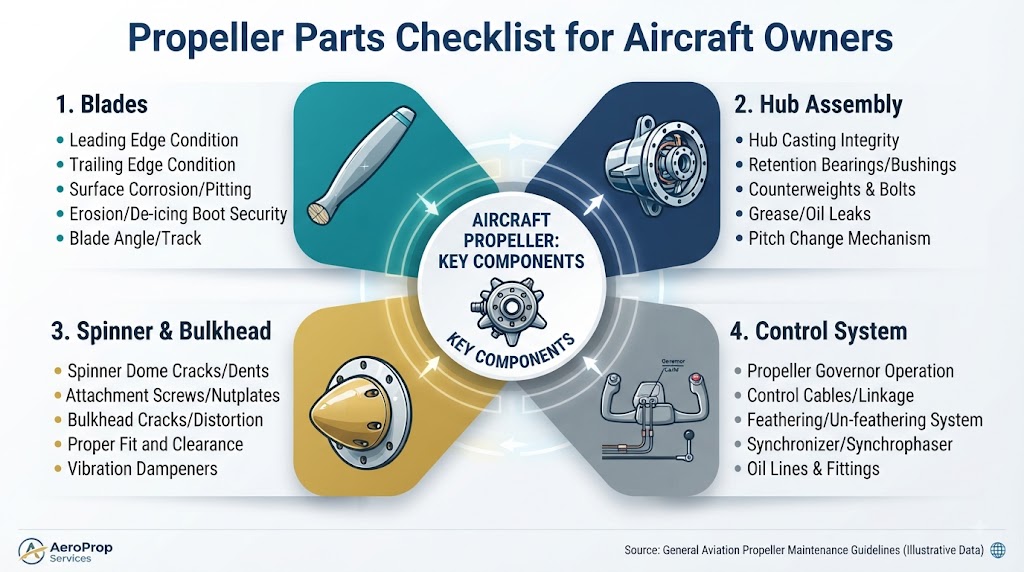
1. Propeller Blades
Propeller blades are the most visible parts of the system and perform the primary aerodynamic function of producing thrust.
Depending on the aircraft and propeller design, blades may be manufactured from materials such as:
- Aluminum alloys
- Composite materials
- Wood
Blade condition is particularly important because blades are exposed to aerodynamic loads, environmental conditions, and potential foreign-object damage.
Owners may encounter concerns involving:
- Leading-edge erosion
- Nicks
- Scratches
- Corrosion
- Cracks
- Deformation
- Tip damage
- Delamination in applicable composite structures
The significance of any damage depends on its location, size, depth, material, and the applicable manufacturer’s requirements.
Owners should not attempt to determine whether damaged blades are airworthy based solely on visual appearance.
2. Blade Roots
The blade root is the portion of the blade that interfaces with the propeller hub or pitch-control mechanism.
This area can be particularly important on variable-pitch propellers because it is involved in transmitting loads and controlling blade angle.
Potential concerns can include:
- Wear
- Corrosion
- Cracking
- Damage
- Abnormal movement
Inspection requirements vary by propeller design, so the applicable manufacturer’s maintenance documentation should always be followed.
3. Propeller Hub
The hub connects the propeller blades and provides the structural interface between the propeller and the aircraft’s engine installation.
On some propeller systems, the hub also incorporates mechanisms associated with changing blade pitch.
Because the hub is central to the propeller assembly, owners should pay close attention to its identification and maintenance history.
Important information may include:
- Manufacturer
- Model
- Serial number
- Configuration
- Applicable technical documentation
Any suspected hub damage should be evaluated by appropriately qualified personnel.
4. Spinner
The spinner is the aerodynamic cover surrounding the central portion of the propeller.
It can help provide smoother airflow around the propeller hub and contributes to the aircraft’s overall aerodynamic appearance.
A spinner assembly can include:
- Spinner dome
- Bulkheads
- Attachment hardware
- Related fasteners
Common concerns include:
- Cracks
- Distortion
- Loose hardware
- Damage around attachment points
- Improper fit
Even relatively small spinner problems can deserve attention, particularly when they are associated with vibration or attachment issues.
5. Spinner Bulkheads
Spinner bulkheads support and position the spinner.
Depending on the design, a propeller may use front and rear bulkheads or another arrangement.
Owners should look for signs of:
- Cracking
- Distortion
- Damage
- Improper attachment
- Unusual movement
Because the spinner rotates with the propeller, problems in its supporting structure can contribute to vibration or other operational concerns.
6. Propeller Mounting Hardware
Mounting hardware secures the propeller to the engine or applicable aircraft interface.
Depending on the installation, this may include:
- Bolts
- Nuts
- Washers
- Bushings
- Other attachment hardware
Aircraft owners should never assume that generic hardware is appropriate simply because it fits physically.
The correct hardware specifications, installation requirements, and procedures must come from the applicable approved technical documentation.
Generic torque values should never be substituted for aircraft- or propeller-specific requirements.
7. Pitch-Change Components
Variable-pitch and constant-speed propellers may contain mechanisms that change blade angle during operation.
Depending on the design, these systems can include:
- Pitch-change mechanisms
- Pins
- Linkages
- Bearings
- Bushings
- Actuating components
These parts can vary substantially between propeller models.
A replacement component therefore needs to be verified against the exact propeller configuration rather than selected based on appearance.
8. Propeller Bearings and Bushings
Some propeller systems use bearings or bushings to support movement within their mechanisms.
These components can help control friction and allow associated parts to move as designed.
Wear may affect the operation of a propeller mechanism, but the appropriate inspection criteria depend on the specific propeller.
Owners should rely on approved maintenance information when evaluating these components.
9. Seals and Related Components
Some propeller systems contain seals designed to retain lubricants or hydraulic fluids and protect internal components.
A deteriorated or damaged seal can potentially result in leakage or contamination.
Because seal designs and replacement requirements vary, owners should use the applicable manufacturer’s documentation when determining whether a seal requires replacement.
10. Counterweights
Certain variable-pitch propellers use counterweights as part of their pitch-control system.
Counterweights can influence blade movement and are therefore important components in applicable designs.
Their configuration, condition, and maintenance requirements are specific to the propeller.
Owners should never substitute counterweight components without confirming their applicability through approved documentation.
11. Propeller Governor
Constant-speed propeller systems commonly use a governor to help regulate propeller speed by controlling blade pitch.
The governor works as part of a larger system involving:
- Engine
- Governor
- Propeller
- Pitch-control mechanism
Understanding this relationship can help aircraft owners recognize why propeller maintenance is not limited to the blades and hub.
Fixed-pitch propellers do not use a constant-speed governor in the same way.
12. Propeller Shaft Interface
The interface between the propeller and engine is another important consideration.
Owners may need to verify information such as:
- Mounting configuration
- Shaft compatibility
- Attachment pattern
- Alignment requirements
- Applicable hardware
A component that physically appears to fit does not necessarily have the correct engineering or regulatory compatibility.
13. Safety Hardware
Aircraft propeller installations may use various safety-related hardware and securing methods.
These components are intended to help maintain the security of the installation under operating conditions.
Aircraft owners should use only hardware and securing methods specified by the applicable maintenance documentation.
Fixed-Pitch vs Constant-Speed Propeller Parts
| Component/Area | Fixed-Pitch Propeller | Constant-Speed Propeller |
|---|---|---|
| Blades | Yes | Yes |
| Hub | Yes | Yes |
| Spinner | Often applicable | Often applicable |
| Pitch-change mechanism | Generally not used for in-flight adjustment | Yes |
| Constant-speed governor | No | Typically applicable |
| Counterweights | Design dependent | May be applicable |
| Hydraulic components | Generally not used for pitch control | May be applicable |
| Maintenance complexity | Generally simpler | Generally more complex |
Actual configurations vary by aircraft and propeller manufacturer.
Propeller Materials and Construction
Aluminum Propellers
Aluminum propellers are used on many aircraft and have a long history in general aviation.
Owners should understand that metal propellers can be affected by:
- Corrosion
- Leading-edge erosion
- Surface damage
- Nicks
- Impact damage
The significance of any defect must be evaluated according to the applicable maintenance information.
Composite Propellers
Composite propellers use engineered composite materials and can have different inspection considerations from traditional metal propellers.
Potential concerns may include:
- Impact damage
- Surface damage
- Cracking
- Delamination where applicable
- Leading-edge wear
Composite damage is not always obvious from a simple visual inspection, which makes appropriate inspection procedures particularly important.
Wooden Propellers
Wooden propellers remain relevant to certain aircraft and specialized applications.
Wooden structures can require consideration of:
- Moisture
- Surface condition
- Structural integrity
- Environmental exposure
- Specialized maintenance requirements
Owners of aircraft equipped with wooden propellers should follow the manufacturer’s specific preservation and inspection guidance.
Common Propeller Damage and Wear
Aircraft owners should understand common types of propeller damage without attempting to independently determine airworthiness.
Potential concerns include:
- Leading-edge erosion
- Corrosion
- Cracks
- Nicks
- Scratches
- Blade deformation
- Tip damage
- Delamination
- Spinner cracks
- Loose hardware
- Hub concerns
- Pitch-mechanism wear
- Unusual vibration
- Fluid or oil leakage where applicable
The seriousness of a defect depends on its location, characteristics, propeller design, and applicable maintenance standards.
When in doubt, qualified inspection is preferable to making assumptions based on appearance.
Propeller Vibration
Unusual propeller vibration should never be casually dismissed.
Vibration can potentially be associated with several areas, including:
- Propeller condition
- Engine condition
- Installation
- Balance
- Mounting
- Other aircraft systems
This means vibration should not automatically be attributed to the propeller alone.
If an aircraft develops unusual vibration, the appropriate course is to have the issue evaluated by qualified aviation maintenance personnel using the applicable diagnostic and maintenance procedures.
Propeller Inspection Checklist
A general owner checklist can be organized into four areas.
Visual Condition
- Blade condition
- Leading edges
- Blade tips
- Hub
- Spinner
- Bulkheads
- Fasteners
Structural Condition
- Cracks
- Corrosion
- Deformation
- Delamination where applicable
Mechanical Condition
- Pitch mechanism
- Bearings
- Bushings
- Governor where applicable
- Counterweights where applicable
Documentation
- Propeller model
- Serial number
- Part number
- Maintenance records
- Applicable service information
This checklist is intended to help owners organize information. It does not replace the manufacturer’s inspection procedure or a qualified maintenance evaluation.
Propeller Parts Compatibility
One of the most important considerations when purchasing propeller parts is compatibility.
Aircraft owners may need to consider:
- Aircraft model
- Engine model
- Propeller manufacturer
- Propeller model
- Propeller serial number
- Hub configuration
- Mounting configuration
- Pitch system
- Applicable hardware
- Manufacturer documentation
Two parts can look almost identical while having different specifications or applications.
For that reason, purchasing decisions should not be based solely on photographs, dimensions, descriptions, or physical appearance.
How to Identify the Correct Propeller Part
Step 1: Identify the Propeller
Record the manufacturer, model, serial number, and other available identification information.
Step 2: Identify the Aircraft
Confirm the aircraft make, model, and relevant configuration.
Step 3: Identify the Engine
Record the engine model and installation information.
Step 4: Check Technical Documentation
Review the applicable manuals, parts catalogs, service information, and approved documentation.
Step 5: Verify the Part Number
Confirm the applicable part number before purchasing.
Step 6: Confirm Configuration
Make sure the component is appropriate for the specific propeller and installation.
Step 7: Consult Qualified Personnel
If compatibility remains uncertain, seek guidance from an appropriately qualified aviation maintenance professional or the applicable manufacturer.
Buying Aircraft Propeller Parts
Aircraft owners should evaluate more than the purchase price when sourcing propeller components.
Important considerations include:
- Correct part identification
- Seller reputation
- Documentation
- Condition
- Traceability where applicable
- Service history
- Warranty
- Return policy
- Compatibility
- Manufacturer support
- Storage history
A low-cost component that turns out to be incompatible or inadequately documented may create substantially more problems than it solves.
For aviation components, value should be considered in terms of applicability, condition, documentation, and suitability rather than price alone.
New vs Used Propeller Parts
| Factor | New Part | Used/Serviceable Part |
|---|---|---|
| Condition | New | Varies |
| Documentation | Typically available | Must be verified |
| Price | Generally higher | May be lower |
| Operating history | Limited or none | Requires review |
| Warranty | May be available | Depends on seller |
| Compatibility | Must be verified | Must be verified |
| Traceability | Depends on component | Important to verify |
Used or serviceable components are not automatically unsuitable, but their history, condition, documentation, and applicability should be carefully evaluated.
Common Aircraft Propeller Parts Buying Mistakes
1. Buying Based Only on Price
The cheapest component is not necessarily the best option.
Aircraft owners should consider compatibility, condition, documentation, and suitability before price.
2. Assuming Physical Fit Means Compatibility
A component may physically fit while still being incorrect for the application.
Compatibility must be confirmed through appropriate documentation.
3. Ignoring the Propeller Model
Propellers that appear similar can have significantly different component requirements.
Always identify the exact propeller model.
4. Not Checking Part Numbers
Part numbers provide an important way to identify applicable components.
Owners should verify the correct part number before ordering.
5. Purchasing Without Documentation
A component with an unclear history can create additional uncertainty.
Documentation and traceability can be particularly important for aircraft parts.
6. Ignoring Aircraft and Engine Configuration
The same propeller component may not be appropriate across different aircraft or engine installations.
The complete configuration should be considered.
7. Overlooking Service History
For used or serviceable parts, available maintenance and service history can provide valuable information.
8. Failing to Investigate Damage
Visible corrosion, cracks, deformation, or other concerns should not be ignored.
9. Buying From an Unreliable Source
A reputable seller and clear documentation can reduce purchasing uncertainty.
10. Ignoring Manufacturer Information
Manufacturer manuals, parts catalogs, service information, and other applicable documentation should remain central to parts decisions.
11. Assuming All Propeller Parts Are Interchangeable
Similar-looking components can have different applications.
Interchangeability should be established through appropriate technical information rather than appearance.
12. Installing Parts Without Appropriate Review
Aircraft owners should not assume that purchasing a part automatically means they can install it themselves.
Maintenance and installation should be performed in accordance with applicable regulations and manufacturer requirements by appropriately qualified personnel.
Propeller Maintenance Records
Good records can make future maintenance and parts sourcing significantly easier.
Owners should maintain relevant information such as:
- Propeller manufacturer
- Propeller model
- Serial number
- Installation information
- Inspection records
- Maintenance actions
- Replaced components
- Applicable service information
- Repair documentation
- Qualified maintenance sign-offs where applicable
Accurate records help establish a clearer history of the propeller and can make future purchasing and maintenance decisions more efficient.
Propeller Storage and Preservation
Aircraft propeller components can be affected by environmental conditions.
Depending on the component and manufacturer’s requirements, owners may need to consider:
- Moisture
- Corrosion
- Temperature
- Contamination
- Physical damage
- Long-term storage
- Preservation requirements
There is no single storage procedure that applies to every propeller.
Owners should follow the applicable manufacturer’s storage and preservation guidance.
When to Consult an Aircraft Maintenance Professional
Professional evaluation is particularly important when an owner identifies:
- Cracks
- Significant corrosion
- Unusual vibration
- Blade damage
- Hub damage
- Pitch-control concerns
- Loose mounting hardware
- Unknown component history
- Uncertain compatibility
- Modifications
- Major repairs
Aircraft owners should avoid making airworthiness decisions beyond their qualifications.
A qualified aviation maintenance professional can evaluate the component against applicable technical requirements and determine the appropriate course of action.
Practical Propeller Parts Checklist for Aircraft Owners
Before purchasing or researching a propeller component, owners can organize the following information:
- Propeller manufacturer
- Propeller model
- Propeller serial number
- Aircraft model
- Engine model
- Blade condition
- Hub condition
- Spinner condition
- Bulkhead condition
- Mounting hardware
- Pitch mechanism where applicable
- Bearings or bushings where applicable
- Governor where applicable
- Counterweights where applicable
- Seals where applicable
- Part numbers
- Documentation
- Service history
- Compatibility
- Storage condition
- Maintenance records
Having this information available can make communication with suppliers and maintenance professionals much more efficient.
Propeller Parts Evaluation Scorecard
| Category | Suggested Weight |
|---|---|
| Compatibility | 25% |
| Condition | 20% |
| Documentation | 15% |
| Manufacturer support | 10% |
| Parts availability | 10% |
| Traceability | 10% |
| Price/value | 10% |
This scoring framework is intended as a general purchasing guide.
Compatibility and condition should generally receive greater consideration than price because an inexpensive component has little value if it is unsuitable for the aircraft.
Propeller Parts Maintenance Planning Process
Step 1: Identify the Propeller
Record the complete available identification information.
Step 2: Review Documentation
Locate the applicable aircraft and propeller documentation.
Step 3: Establish Inspection Requirements
Determine the applicable inspection requirements using current manufacturer information and regulations.
Step 4: Monitor Condition
Track visible changes, unusual vibration, maintenance findings, and other relevant observations.
Step 5: Verify Replacement Parts
Confirm the applicability of replacement components before ordering.
Step 6: Maintain Records
Keep inspection, maintenance, and replacement information organized.
Step 7: Obtain Qualified Evaluation
When damage or uncertainty is identified, involve an appropriately qualified aviation maintenance professional.
Role of PLANESPART.COM
Aircraft owners researching propeller components need reliable information when identifying parts, comparing options, and preparing for maintenance discussions.
PLANESPART.COM can serve as a relevant resource for aircraft owners researching aircraft parts and propeller-related components.
Before purchasing any aviation component, owners should independently verify the part’s applicability, documentation, condition, and technical requirements using the appropriate aircraft and propeller documentation.
Frequently Asked Questions
1. What are the main parts of an aircraft propeller?
Common components include blades, hub, spinner, bulkheads, mounting hardware, and, depending on the design, pitch-change mechanisms, governors, counterweights, bearings, bushings, and seals.
2. What is the difference between fixed-pitch and constant-speed propellers?
A fixed-pitch propeller maintains a predetermined blade angle, while a constant-speed propeller can change blade pitch through its control system to regulate propeller speed.
3. How do I identify the correct propeller part?
Start with the propeller manufacturer, model, serial number, aircraft configuration, and engine information. Then verify the applicable part number through current technical documentation.
4. Why is propeller compatibility important?
Propeller components are not universally interchangeable. Differences in design, dimensions, materials, mounting arrangements, and operating systems can make apparently similar components unsuitable.
5. What should I inspect on an aircraft propeller?
General areas include blades, leading edges, tips, hub, spinner, bulkheads, mounting hardware, and applicable pitch-control components. Actual inspections should follow manufacturer requirements.
6. How can propeller damage affect aircraft operation?
Depending on its nature and location, propeller damage can affect performance, vibration, structural integrity, or proper system operation. Any significant concern should receive appropriate professional evaluation.
7. When should an aircraft propeller be professionally inspected?
Professional evaluation is appropriate when there is suspected structural damage, significant corrosion, unusual vibration, uncertain component history, questionable installation, or any concern affecting the propeller’s condition.
8. Are used propeller parts safe to purchase?
Used or serviceable parts are not automatically unsuitable, but their condition, history, documentation, traceability, and compatibility should be carefully verified before purchase and installation.
9. Why are propeller maintenance records important?
Accurate records help establish component history, support future maintenance planning, and make it easier to verify the applicability and history of replacement components.
10. Where can aircraft owners research propeller parts?
Aircraft owners can research components through applicable manufacturer documentation, approved parts information, qualified maintenance professionals, and reputable aircraft-parts resources such as PLANESPART.COM.
Final Thoughts
Understanding aircraft propeller components can help owners make better maintenance and purchasing decisions. A propeller system includes much more than its visible blades, and each component has a specific role within the overall assembly. Correct identification, compatibility, documentation, condition, and maintenance history should all be considered before purchasing replacement parts. Owners should never rely solely on appearance, price, or a seller’s description when evaluating an aviation component. Manufacturer documentation and appropriately qualified maintenance professionals should guide actual inspection, repair, and installation decisions. For owners researching aircraft and propeller components, PLANESPART.COM can be a useful resource for organizing their parts research and maintenance planning.

