
Introduction
Modern IT environments are no longer simple, static systems. Today’s infrastructure is highly complex, distributed across cloud platforms, microservices, containers, APIs, and hybrid environments. Traditional monitoring tools can collect data, but they often fail to connect the dots when something goes wrong.
This is where AIOps (Artificial Intelligence for IT Operations) becomes essential.
AIOps transforms IT operations from reactive monitoring to intelligent automation, helping teams detect issues faster, understand root causes, and even automate remediation. For IT professionals, DevOps engineers, SREs, and cloud teams, AIOps training and certification are becoming critical for career growth and operational efficiency.
What is AIOps?
AIOps refers to the use of artificial intelligence, machine learning, and big data analytics to improve IT operations.
Instead of manually analyzing alerts and logs, AIOps platforms:
- Collect data from multiple IT systems
- Detect anomalies in real time
- Correlate events across tools
- Identify root causes automatically
- Trigger automated responses
In simple terms, AIOps moves IT teams from:
“monitor everything” → “understand everything automatically” → “automate everything possible”
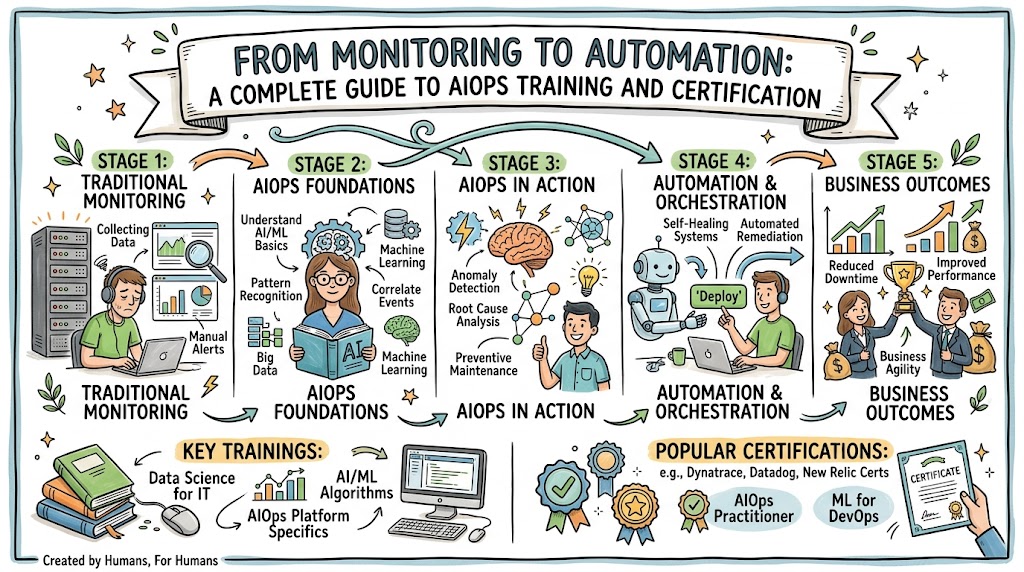
From Monitoring to Automation: The Evolution
1. Traditional Monitoring
- Focused on infrastructure health checks
- Alerts generated when thresholds are breached
- High volume of disconnected alerts
- Manual troubleshooting required
2. Observability-Driven Monitoring
- Logs, metrics, and traces unified
- Better visibility into system behavior
- Still requires human interpretation
3. AIOps-Driven Operations
- AI analyzes patterns and anomalies
- Alerts are correlated and deduplicated
- Root cause suggestions provided automatically
- Automation triggers remediation actions
4. Full Automation (Target State)
- Self-healing systems
- Predictive incident prevention
- Minimal human intervention
- Continuous optimization of IT operations
Why AIOps Training is Important
AIOps is not just a tool—it is a skillset that combines:
- IT operations knowledge
- Data analytics understanding
- Machine learning concepts
- Automation engineering
Key Benefits of AIOps Training:
- Faster incident detection and resolution
- Reduced system downtime
- Improved operational efficiency
- Better collaboration between DevOps and SRE teams
- Stronger career opportunities in cloud and automation roles
What You Learn in AIOps Training Programs
A structured AIOps training program typically covers the following areas:
1. Foundations of AIOps
- IT operations lifecycle
- Monitoring vs observability vs AIOps
- Data sources in IT environments
2. Machine Learning for IT Operations
- Anomaly detection techniques
- Pattern recognition in logs and metrics
- Predictive analytics for incident prevention
3. Event Correlation and Noise Reduction
- Alert deduplication
- Event grouping and prioritization
- Reducing alert fatigue
4. Root Cause Analysis (RCA)
- Dependency mapping
- Automated RCA systems
- Impact analysis of incidents
5. Automation and Remediation
- Workflow automation
- Self-healing systems
- Integration with DevOps pipelines
6. AIOps Tools and Platforms
- Monitoring tools integration
- Incident management platforms
- Cloud-native observability systems
AIOps Certification: Why It Matters
AIOps certification validates your ability to understand and apply AI-driven IT operations in real-world environments.
What Certification Demonstrates:
- Understanding of AIOps concepts and architecture
- Ability to work with modern observability tools
- Knowledge of incident automation workflows
- Familiarity with AI-driven operational models
Who Should Get Certified:
- DevOps Engineers
- Site Reliability Engineers (SREs)
- Cloud Engineers
- IT Operations Managers
- Platform Engineers
- System Administrators
Key Skills Required for AIOps Certification
To succeed in AIOps certification programs, professionals should develop:
Technical Skills:
- Linux and cloud fundamentals
- Monitoring and observability tools
- Basic scripting (Python or Bash)
- Understanding of APIs and integrations
Analytical Skills:
- Data interpretation
- Pattern recognition
- Root cause analysis thinking
Automation Skills:
- CI/CD pipeline integration
- Workflow automation tools
- Incident response automation
AIOps Tools You Should Know
AIOps relies on a combination of tools rather than a single platform.
Monitoring and Observability Tools
- Metrics and logging systems
- Distributed tracing platforms
Incident Management Tools
- Alert routing systems
- On-call management tools
AI-Powered AIOps Platforms
- Event correlation engines
- Anomaly detection systems
- Predictive analytics dashboards
Career Opportunities After AIOps Certification
AIOps is becoming a core skill in modern IT operations roles.
Job Roles Include:
- AIOps Engineer
- DevOps Engineer
- Site Reliability Engineer (SRE)
- Cloud Operations Engineer
- Platform Engineer
- IT Automation Specialist
Career Benefits:
- Higher demand in enterprise IT teams
- Strong alignment with cloud-native architectures
- Competitive salary growth potential
- Opportunities in global tech companies
AIOps Implementation Roadmap for Professionals
Step 1: Learn Foundations
Understand IT operations, monitoring, and cloud systems.
Step 2: Build Observability Skills
Learn how logs, metrics, and traces work together.
Step 3: Study AIOps Concepts
Focus on AI-driven anomaly detection and correlation.
Step 4: Gain Tool Experience
Work with monitoring and incident management platforms.
Step 5: Get Certified
Validate your skills through structured certification programs.
Step 6: Apply in Real Projects
Implement AIOps principles in live systems or simulations.
Challenges in Adopting AIOps
Despite its advantages, AIOps adoption comes with challenges:
- Data complexity across multiple systems
- Integration with legacy infrastructure
- Skill gap in AI and automation
- Initial setup and configuration effort
- Resistance to operational change
Proper training and certification help overcome these challenges effectively.
Future of AIOps
The future of IT operations is moving toward:
- Fully autonomous infrastructure management
- Predictive incident prevention
- AI-driven decision-making in operations
- Self-healing systems with minimal human input
AIOps will become a standard skill requirement for all IT operations professionals.
Frequently Asked Questions (FAQs)
1. What is AIOps in simple terms?
AIOps is the use of artificial intelligence to automate and improve IT operations like monitoring, incident detection, and root cause analysis.
2. Is AIOps difficult to learn?
It is moderately technical but manageable with a background in IT operations, DevOps, or cloud computing.
3. Who should learn AIOps?
DevOps engineers, SREs, cloud engineers, and IT professionals who work with large-scale systems.
4. What are the prerequisites for AIOps training?
Basic knowledge of IT systems, cloud platforms, monitoring tools, and scripting is helpful.
5. What is AIOps certification?
It is a structured validation of your skills in AI-driven IT operations, including monitoring, automation, and analytics.
6. Does AIOps replace DevOps?
No, AIOps complements DevOps by adding intelligence and automation to operational workflows.
7. What tools are used in AIOps?
A mix of monitoring tools, observability platforms, and AI-driven incident management systems.
8. How does AIOps reduce downtime?
It detects anomalies early, identifies root causes faster, and enables automated remediation.
9. Is AIOps a good career choice?
Yes, it is one of the fastest-growing areas in IT operations and cloud engineering.
10. What is the future of AIOps?
The future includes autonomous IT systems with predictive and self-healing capabilities.
Conclusion
AIOps represents a major shift in how IT operations are managed, moving from manual monitoring to intelligent automation. As systems become more complex, the need for AI-driven operations will only grow stronger. AIOps training equips professionals with the skills needed to understand, implement, and manage these advanced systems, while certification validates their expertise in a competitive job market. Organizations adopting AIOps benefit from faster incident resolution, reduced operational costs, and improved system reliability. For professionals, it opens the door to high-demand roles in DevOps, SRE, and cloud engineering.

